

Hello Avatar! Welcome to another week of biotech analysis. Today’s commentary, as always on Thursday, focuses on the general market update. This week confirmed the playbook. Biotech can rally and capital can return quickly, but funding is flowing to companies with clean catalysts and tight execution. Secondaries continue to dominate the financing landscape, while IPO activity remains scarce. Investors are rewarding near-term proof and punishing duration risk. In this environment, cost of capital shapes trial design, and clock discipline matters as much as mechanism.
We are now publishing 7x per week according to the following cadence:
Mondays: Stocks
Tuesdays: Biotech
Wednesdays: Podcast
Thursdays: Markets
Fridays: News
Saturdays: Podcast
Sundays: Strategy
We are also publishing unique content on X - be sure to follow up if you are not already @BowTiedBiotech. And to check-out the archive of our work on X you can find it on our website at: BowtiedBiotech.subtack.com/x-articles.
SUBSCRIBE TO PODCAST HERE:
Please help spread the work by subscribing and hitting the share button if you are enjoying content!
Lots to cover this week, let's get started!

Macro Update
Global sovereign bond markets are flashing a warning that the easy-money era is not coming back quietly. Long-term borrowing costs across the U.S., Europe and Japan surged to multi-decade highs this week as investors demanded more compensation for inflation risk, worsening fiscal deficits and increasingly heavy government debt issuance. The U.S. 30-year Treasury yield touched 5.337% on Tuesday, its highest level since 2007, while Germany’s 10-year yield briefly reached a 15-year high and Japan’s 10-year yield climbed to levels last seen in 1996. The move became disorderly enough that the U.S. Treasury announced it would double certain long-duration bond buybacks from $2B to at least $4B per operation, which helped pull the 30-year yield back toward 5.2%.
For biotech, the transmission mechanism is pretty straightforward. Pre-revenue biotech is effectively a long-duration asset, where the majority of the theoretical value sits in cash flows that may not materialize for another five, seven or ten years. When investors can earn ~5% in long-dated Treasuries without taking clinical, regulatory or commercialization risk, the required return for owning a Phase 1 or Phase 2 biotech necessarily goes higher. That means lower present values for distant pipeline cash flows, lower multiples investors are willing to pay for optionality, and less tolerance for companies whose investment case depends on repeated rounds of external financing.

The more important impact is probably on financing rather than headline valuation. Higher risk-free rates make already expensive biotech capital even more expensive, which disproportionately hurts companies with short runways, large Phase 3 programs or no obvious partnering path. A company that needs $200M to reach its next meaningful inflection point does not get to reduce that requirement because its stock price has fallen 40%. Instead, it issues more shares, accepts worse financing terms, cuts programs or tries to sell an asset from a weaker negotiating position. The result should be greater dispersion across the sector, with cash-rich companies and genuinely differentiated assets retaining access to capital while marginal programs get increasingly difficult to finance.
There is an M&A angle here as well. Large pharma generally has stronger balance sheets, existing cash flows and substantially better access to debt markets than the average development-stage biotech, so prolonged pressure on long-duration valuations can shift negotiating leverage toward buyers. That does not automatically mean an M&A boom. Buyers can also afford to wait while biotech sellers burn cash and become cheaper. If long-term yields remain elevated, the more likely outcome is continued pressure on weaker balance sheets, selective takeouts of high-quality assets, and increasingly punitive outcomes for companies that need the capital markets to bail out mediocre pipelines. For biotech, the key macro question is therefore less whether the Fed cuts 25 bps at the next meeting and more whether the long end of the curve stays structurally expensive.
Introduction
This week, we look at why Big Pharma increasingly prefers to buy the drug instead of the company around it. The shift sounds like a dealmaking detail, but it reaches much further upstream. It changes how biotechs should design Phase 1 studies, which translational experiments create real value, how cleanly a program needs to transfer between organizations, and even how companies should structure their pipelines from day one. If pharma is paying for reduced uncertainty at the asset level, then the winners will be the teams that can turn biology into a portable therapeutic package faster than everyone else.
The quiet change in what pharma is actually buying
Something strange is happening in biotech dealmaking.
Big Pharma still needs external innovation badly. Patent expirations are coming. Internal research productivity remains uneven. Large companies have plenty of therapeutic areas where they need another growth asset. None of that changed. What has changed is what buyers seem willing to pay for. Increasingly, the valuable unit is a drug with enough evidence around it to move into an existing pharma machine. The company that discovered it can become almost incidental.
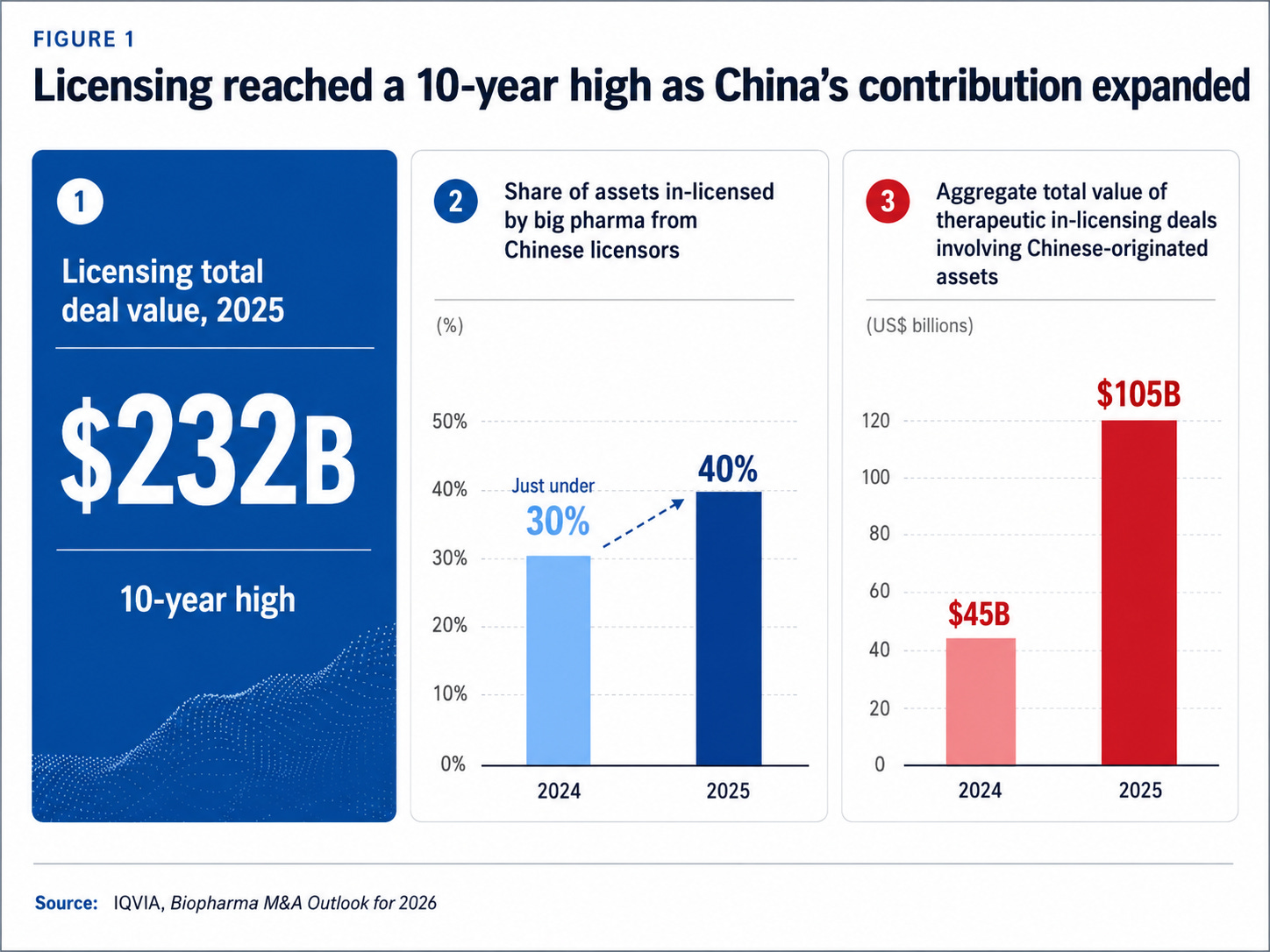
The numbers support that shift. IQVIA reported that licensing reached a ten year high of roughly $232 billion in total deal value during 2025. Forty percent of assets licensed by large pharma came from Chinese licensors. That was up from just under 30 percent one year earlier. Licensing volume did not explode. Buyers simply paid more for the assets they actually wanted. Clinical stage programs took a larger share of therapeutic licensing activity as buyers concentrated on programs with established development paths.
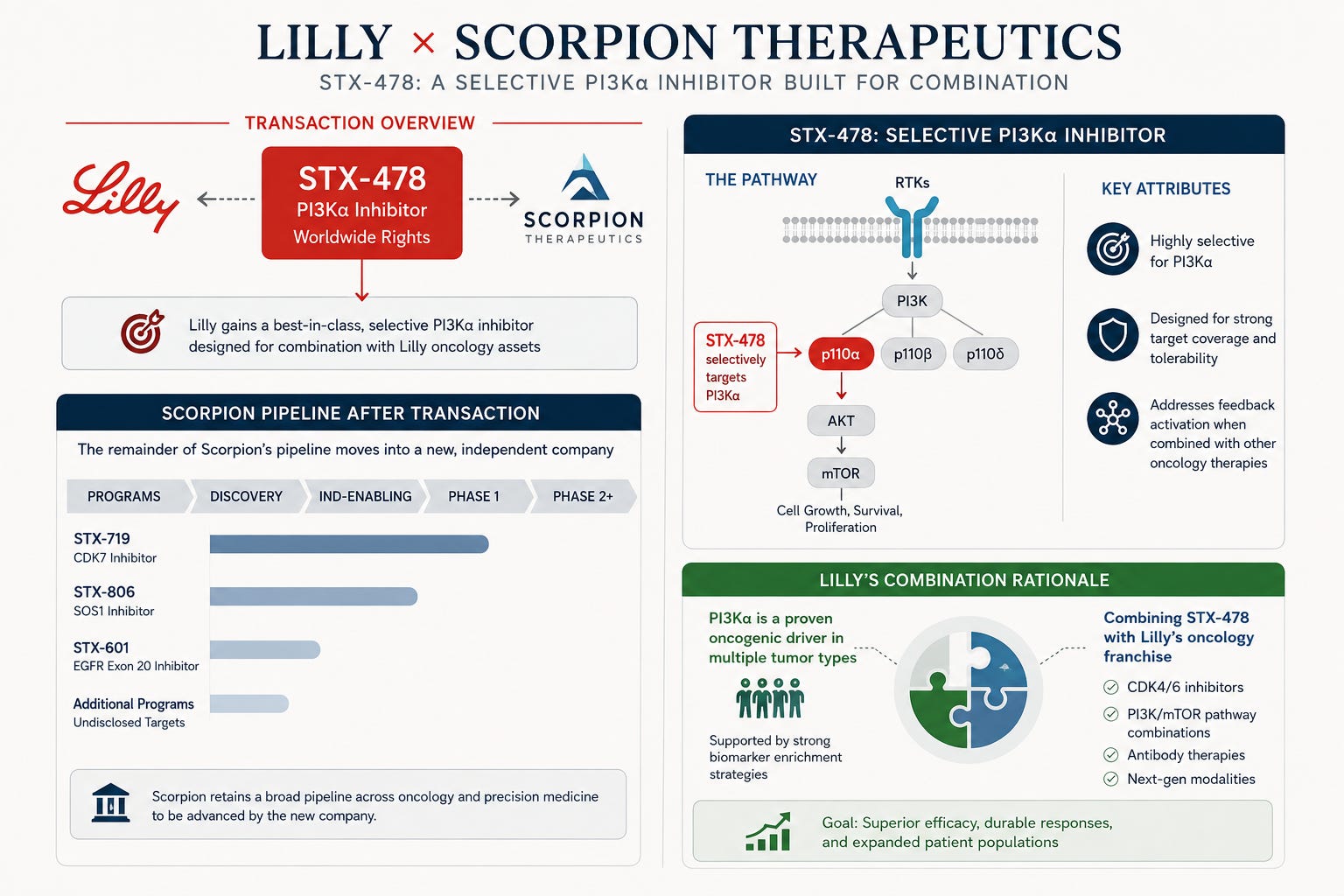
Look at what pharma has actually done. Pfizer paid 3SBio $1.25 billion upfront for rights to SSGJ 707 outside China, plus a $100 million equity investment, while leaving 3SBio intact. Sanofi paid $600 million upfront for DR 0201 by acquiring a subsidiary created around the asset. Lilly structured its Scorpion transaction so STX 478 went to Lilly while the rest of Scorpion moved into a new company. AbbVie did nearly the same thing with Gilgamesh and bretisilocin. The details differ, but the message keeps repeating. Pharma increasingly wants the piece of biology it can use. It does not automatically want the people, leases, discovery portfolio, old programs, corporate overhead, or scientific mythology wrapped around it.
The molecule is becoming the real company
Biotech investors spend a lot of time discussing companies. Pharma business development teams often think much more narrowly.
A buyer sees a molecule, an indication, an IP estate, a manufacturing process, a safety package, an exposure curve and a clinical development plan. Then it asks whether those pieces fit something it already owns. That difference sounds subtle. It changes how therapeutic value gets created. If the buyer already has oncology operations, global trial infrastructure, manufacturing capacity and commercial relationships, acquiring another organization that duplicates those capabilities creates work. Licensing one molecule plugs an asset directly into infrastructure that already exists.
That explains why a drug can command a valuation that looks absurd relative to the company that produced it. Pfizer agreed to pay up to $4.8 billion in milestones on top of its $1.25 billion upfront payment for SSGJ 707. BMS agreed to pay BioNTech $1.5 billion upfront and another $2 billion in noncontingent payments for a partnership around BNT327, with up to $7.6 billion more available through milestones. These numbers make little sense if you think the buyer is purchasing laboratory output. They make more sense if you think the buyer is purchasing the right to redirect an existing clinical and commercial machine toward a molecule that has already cleared part of the scientific uncertainty.
This is where biotech investors often get the framework backwards. They ask whether a platform has generated enough programs to deserve a platform valuation. Pharma can ask a simpler question. Which program changes my franchise if it works? Everything else becomes negotiable. That creates a harsh outcome for mediocre pipelines. A company can own six drugs and discover that only one matters. It also creates an interesting outcome for genuinely good discovery engines. You no longer need to sell the entire engine to monetize its output. You can sell one product, keep the machinery, reload the company and do it again.
Translation is becoming the product
Here is the part I think matters most.
The real asset being purchased is rarely just the molecule. Pharma is buying a package of reduced uncertainty around the molecule. Medicinal chemistry has already happened. The formulation exists. Toxicology has survived. Human exposure has started to make sense. The drug reaches the target. Something measurable happens downstream. Maybe early efficacy appears. Each answer removes one reason the program could die.
That makes translational development much more important than the traditional biotech narrative suggests. A beautiful animal model does not transfer cleanly into a pharma portfolio. A human dose response does. A clever mechanism does not tell a buyer whether the drug combines with standard therapy. Human safety data starts answering that. A broad platform slide can imply twenty future drugs. One biopsy showing target engagement at a clinically tolerable exposure can be worth more than the slide deck. The buyer pays when uncertainty falls faster than price rises.
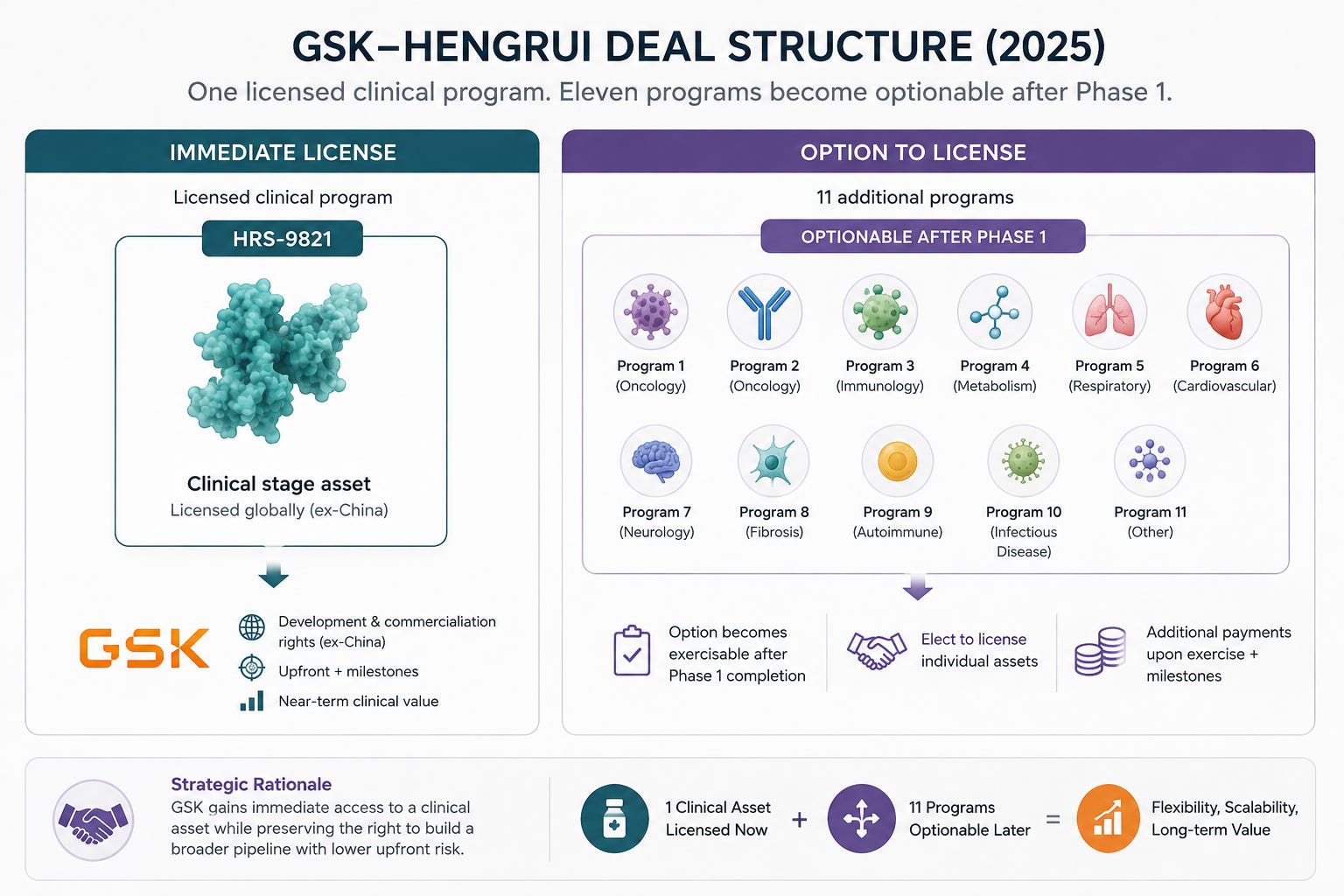
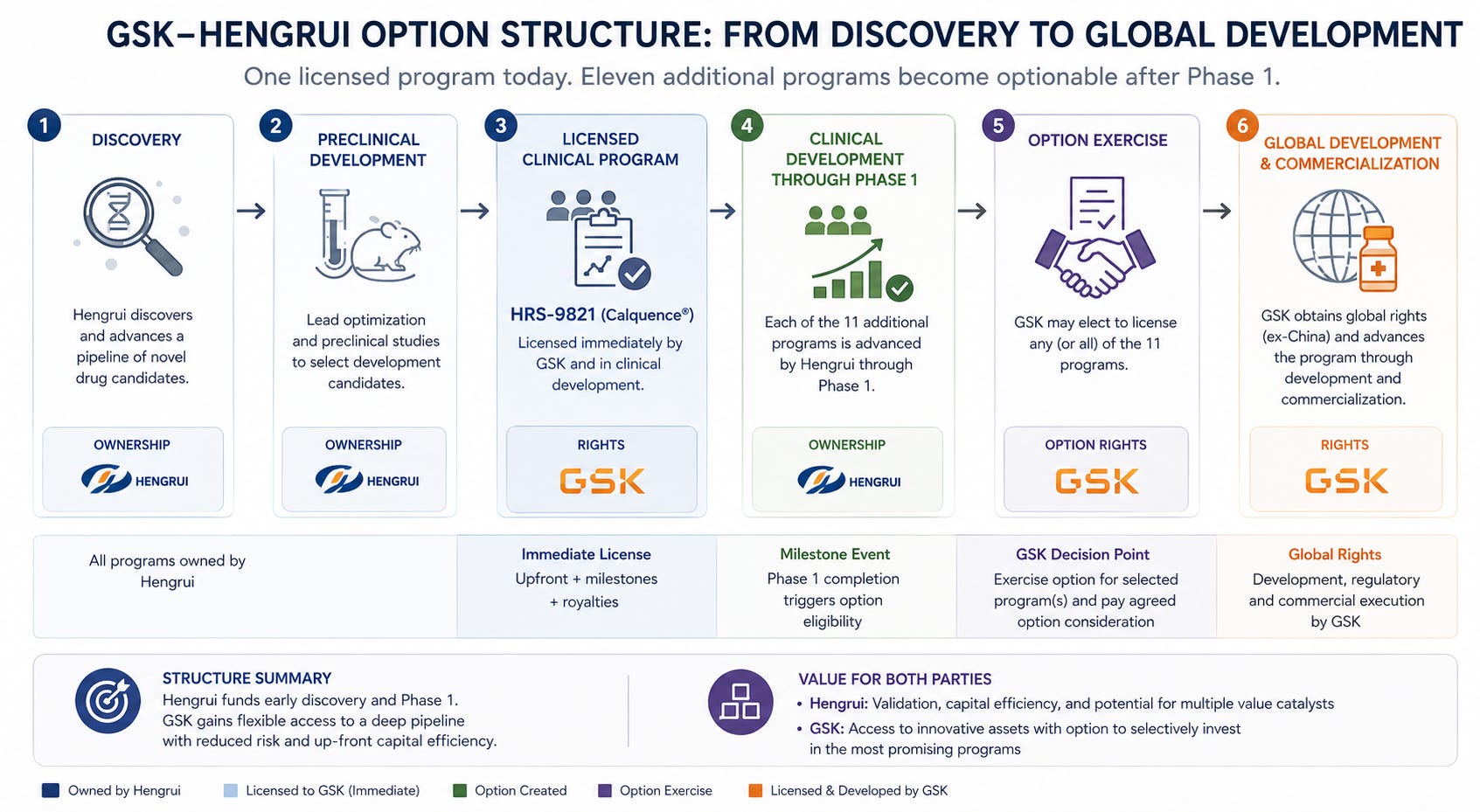
You can see that logic in GSK’s 2025 agreement with Hengrui. GSK took an immediate license to one clinical program, HRS 9821, then received options on another eleven programs after Hengrui advances them through Phase 1. That detail deserves more attention than the headline $12 billion potential deal value. GSK effectively defined the handoff point. Hengrui does the early work. Human data arrive. GSK then decides whether each molecule deserves entry into its global development system. The Phase 1 trial becomes more than a safety study. It becomes a commercial interface between two research organizations.
Phase 1 is turning into a transaction
That deserves its own section because it changes how early therapeutic programs should be built.
Historically, people treated Phase 1 as the boring part. Establish tolerability. Characterize PK. Pick a dose. Then wait for the efficacy study that investors actually care about. That framework looks increasingly outdated for assets designed to be partnered. A well designed Phase 1 program can answer several questions that materially alter what a buyer will pay. Does exposure cover the predicted active range. Does a blood or tissue biomarker move. Does the pharmacology scale with dose. Does safety leave enough room for combination therapy. Can the formulation support chronic dosing.
The gap between a merely safe drug and a commercially transferable drug gets wide very quickly. Imagine two compounds against the same target. Drug A shows no major safety signal and reaches the expected concentration. Drug B does the same thing but also shows target engagement in tissue, a clean exposure response relationship and tolerability at several times the pharmacologically active concentration. Scientists may call both Phase 1 successes. A business development team will not value them the same way. Drug B gives the buyer a map. Drug A gives the buyer another experiment.
This creates a practical change for biotech management teams. The objective of first in human development should increasingly include making the asset legible to an outside organization. That means designing translational assays before the trial starts, collecting tissue when it matters, building pharmacodynamic readouts that survive diligence and understanding what exposure a future combination regimen requires. Some companies will spend more money in Phase 1 because of this. That sounds wasteful until one extra cohort converts a vague mechanism into a licensable asset.
Combinability is becoming an invisible valuation metric
One of the more interesting clues sits inside Lilly’s explanation for buying STX 478.
Lilly did not simply emphasize that the drug inhibits mutant PI3K alpha. The company highlighted the possibility that selectivity creates a differentiated tolerability profile and allows STX 478 to combine with standard therapies. Lilly specifically pointed toward earlier treatment settings where combination use matters. That tells you something about how pharma sees the asset. The value does not stop at monotherapy activity. The value includes where Lilly can insert the drug across an existing breast cancer treatment architecture.
This creates a metric that most biotech screens barely capture. Call it combinability. A molecule with moderate standalone efficacy but excellent tolerability, predictable PK and minimal overlapping toxicity can become more valuable to a strategic buyer than a more potent drug that creates a therapeutic dead end. Oncology makes this obvious, but the principle extends into immunology, metabolic disease and neuroscience. Pharma develops franchises. A new molecule becomes more valuable when it expands what the existing franchise can do.
That should affect translational strategy much earlier. Developers usually optimize a drug against competitors. They should also optimize against the therapies they expect the drug to live beside. The right preclinical toxicology package changes. The relevant drug interaction studies change. Biomarker selection changes. Even dose selection changes. If the eventual value of a molecule comes from becoming component B inside somebody else’s regimen, proving that compatibility early can produce more strategic value than squeezing another few points of monotherapy response from a small trial.
CMC is part of translation whether investors like it or not
Scientists often separate therapeutic translation from manufacturing. Buyers cannot.
A drug that works but cannot be transferred into a buyer’s manufacturing system without a year of process repair is a different asset from one with a clean production history, characterized impurities, reproducible release assays and a scalable process. The clinical graph can look identical. The transaction value is not identical. Pharma is purchasing time as much as science.
Pfizer’s SSGJ 707 agreement offers a useful clue. Pfizer disclosed plans to manufacture drug substance in North Carolina and drug product in Kansas. That means a molecule discovered and clinically advanced by another company must eventually enter Pfizer’s own manufacturing network. The handoff therefore includes much more than sequence information and clinical data. Pfizer needs analytical methods, process knowledge, reference materials, stability information and enough CMC maturity to transfer production without breaking comparability.
This matters more as asset transactions become common. When you buy the whole company, the scientists who know why batch 17 behaved strangely come with the building. When you buy only the drug, undocumented knowledge becomes a liability. I expect sophisticated buyers to push CMC diligence earlier and harder. For biotechs, this means boring operational work can create transactional value. Clean notebooks matter. Assay validation matters. Process history matters. You rarely see these items in a sell side model because they do not fit neatly into probability of success. They show up when two similar assets reach diligence and one buyer walks away.
China exposed the model first
The rise of Chinese licensing gets described as a cost story or a speed story. Both are true. Neither fully explains what Big Pharma appears to value.
IQVIA reported that Chinese licensors accounted for roughly 40 percent of assets licensed by large pharma in 2025. Total value associated with therapeutic licenses involving Chinese originated assets more than doubled from about $45 billion in 2024 to roughly $105 billion in 2025. That happened because Chinese developers increasingly produced assets that arrived at the negotiating table with human data. Pharma did not need to believe a five year platform story. It could look at exposure, response, safety and competitive positioning.
The deeper shift is that China has become extremely effective at turning targets into transaction ready clinical packages. GSK’s Hengrui structure makes this explicit. Hengrui advances programs into humans. GSK receives options after Phase 1. Pfizer’s 3SBio deal went further. SSGJ 707 already had multiple clinical studies underway in China, with Phase 3 development planned. Merck licensed HRS 5346 from Hengrui for $200 million upfront and up to $1.77 billion in milestones. These deals let Western pharma inspect real human translation before committing the full economics of internal development.
Here is the part people should worry about. This creates a new benchmark for every Western biotech. You are no longer competing only against another Boston or San Diego company with the same target. You are competing against a global asset market where another group can take a molecule into humans quickly, price the deal around a specific program and let the buyer ignore the rest of the organization. A Western biotech asking pharma to pay for its platform premium has to explain why the buyer should do that when it can purchase a clinically translated molecule somewhere else.
The biotech company is becoming a temporary wrapper
Scorpion and Gilgamesh show where this gets weird.
Lilly wanted STX 478. Scorpion had other programs, employees and discovery capabilities. Rather than force everything into one transaction, Scorpion agreed to spin those pieces into a new independent company owned by existing shareholders, with Lilly retaining a minority interest. AbbVie later used a similar structure around Gilgamesh. AbbVie acquired bretisilocin while the remaining programs and employees moved into a new Gilgamesh entity.
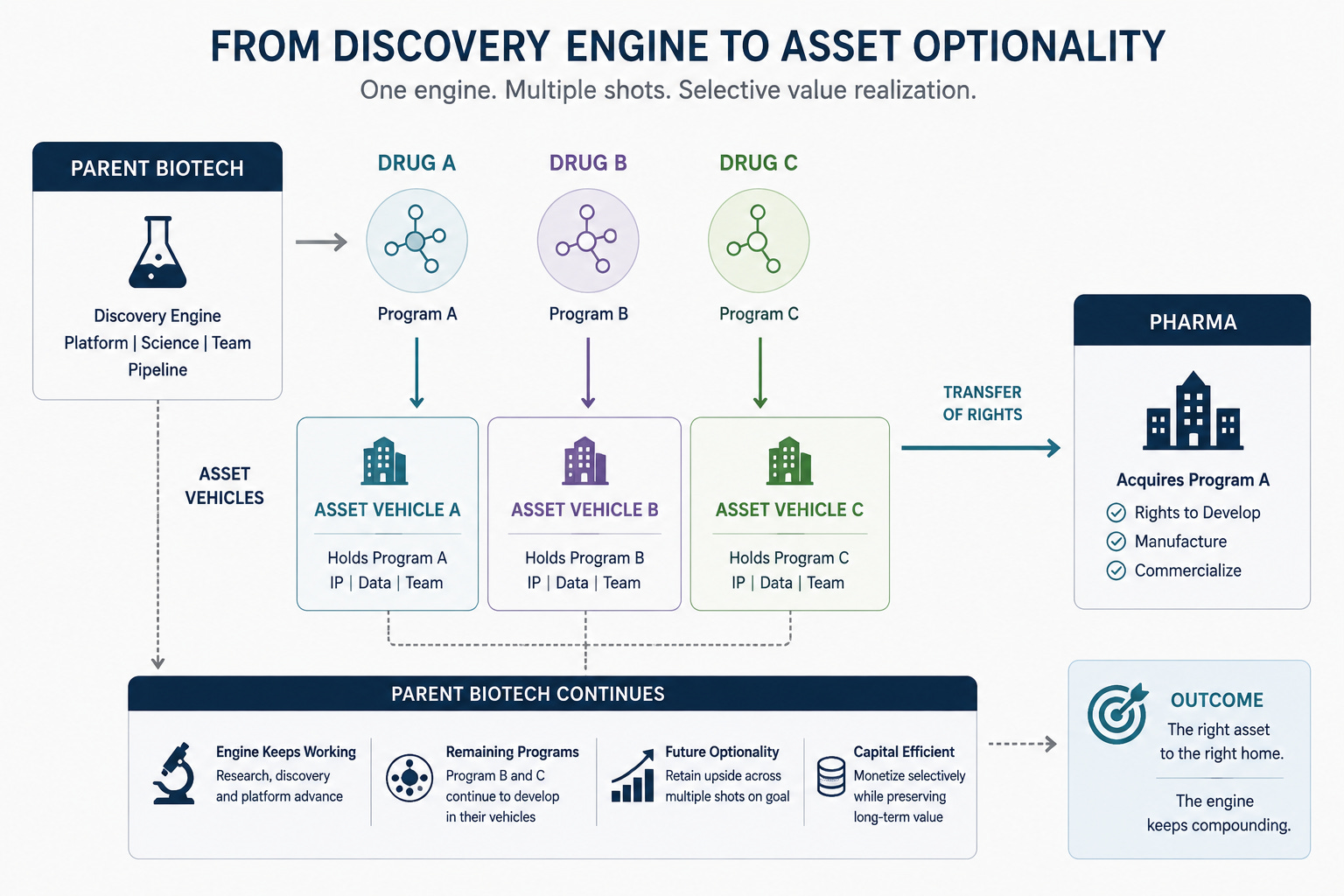
That corporate structure says something important about biotech. The company does not necessarily need to be permanent. It can function as a wrapper around several therapeutic assets until one becomes valuable enough to separate. Then capital and ownership reorganize around the biology. The old assumption that success means selling the entire company starts to look unnecessarily rigid. A discovery organization can produce an asset, monetize it, preserve everything else and repeat the process.
I expect more companies to design themselves for this from day one. Separate IP assignments by program. Cleaner intercompany licensing. Standalone CMC packages. Teams organized so one program can move without taking half the company. Even financing could move in this direction. Investors can fund a parent discovery organization while asset specific subsidiaries hold individual programs. If one drug becomes interesting to pharma, the buyer purchases the subsidiary. Everybody avoids months of arguing over unrelated programs. Sanofi’s acquisition of the Dren 0201 affiliate already looks close to this structure. Sanofi paid $600 million upfront for the entity containing DR 0201 while Dren Bio continued independently with the rest of its pipeline.
This changes which science gets funded
There is an uncomfortable downside.
An asset driven market rewards science that becomes legible quickly. Validated targets become attractive. Biomarkers help. Diseases where early human pharmacology can answer something useful become easier to finance. Programs that require six years of platform building before the first clean human test become harder to explain. That does not mean the harder science is worse. It means the transaction market has developed a preference for uncertainty that can be removed in increments.
You can already see the consequence in deal statistics. IQVIA found that collaborative research alliances fell to a five year low in 2025 while buyers concentrated more capital into clinically validated licensing opportunities. That tells me pharma increasingly prefers to let someone else perform part of the discovery and early translation work, then enter when a program becomes easier to underwrite.
There is a risk here that people should not ignore. If every venture fund starts building for a Phase 1 license, biotech research becomes optimized around what can be sold rather than what medicine needs. Some mechanisms need long experiments. Some modalities need years of enabling work. Some diseases do not produce an easy blood biomarker after four weeks. Those programs can lose capital even when their ultimate therapeutic value is higher. The market can become very good at producing transaction ready drugs and less good at funding strange science. That creates an opportunity for patient capital, but only if the underlying biology deserves it. Most weird science still fails.
The new translational moat
People use the word moat loosely in biotech. Patents matter. Platforms matter sometimes. I think another moat is becoming more important.
The moat is the ability to repeatedly convert uncertain biology into clean human evidence faster than competitors.
That sounds simple. It is not. You need disease biology good enough to choose the right target. Medicinal chemistry good enough to create a useful molecule. Translational science good enough to design a human readout. Clinical operations good enough to get an answer quickly. CMC good enough that the asset can leave your hands. The company that can repeatedly do those things becomes a supplier to global pharma rather than a binary single product bet.
This is where the platform concept gets interesting again. The best platform company of the next decade may not be the company claiming that one technology can generate fifty drugs. Pharma has heard that pitch. The more valuable platform may be an organization that demonstrates it can manufacture transaction ready therapeutic packages over and over. Hengrui starts to look like that. A few Western companies can become that. Investors should watch whether a company’s second asset reaches human proof faster and with better translational design than its first. That tells you whether learning compounds inside the organization. If it does, the platform has value. If every new program starts from zero, you probably own a collection of projects.
Investors are looking at the wrong acquisition screens
Most biotech M&A screens focus on market capitalization, cash runway, therapeutic area and Phase 2 data. Those variables matter. They miss the strategic part.
A more useful screen starts with the buyer. Which pharma company already has the clinical infrastructure, combinations, sales force or disease expertise that makes this particular asset worth more inside its portfolio than outside it. Lilly’s interest in STX 478 becomes easier to understand when you view it through breast cancer strategy. GSK’s acquisition of Nuvalent for $10.6 billion in 2026 fits its push into lung cancer and creates adjacency with its own oncology assets. Sanofi’s DR 0201 deal slots directly into immunology. The molecule matters. Strategic fit changes the price.
I would screen assets using a different set of questions.
Has the drug shown human target engagement at tolerable exposure
Can the mechanism plug into a pharma franchise that already exists
Does the safety profile support combinations or chronic use
Does the seller control clean global rights
Can manufacturing transfer without rebuilding the process
Is there a clinical experiment within the next twelve to eighteen months that removes a major piece of uncertainty
Can the asset separate from the company without destroying the remaining organization
The last question barely appears in biotech research. I think it will matter more. A company with one attractive asset and five liabilities creates transaction friction. A company that can sell the attractive asset cleanly has more strategic paths. Investors should start treating corporate architecture as part of asset value.
Watch the option deals
Full acquisitions get headlines. Option agreements can tell you more.
GSK’s Hengrui transaction lets GSK watch eleven programs progress before deciding whether to take them. That is essentially a portfolio of therapeutic call options. Pharma gains access to innovation without immediately carrying every development risk. The biotech gets capital and validation while retaining responsibility for reaching a defined proof point. This structure aligns naturally with the translational handoff model.
I expect option deals to move earlier while exercise points become more specific. Instead of vague language around clinical progress, buyers will increasingly define the evidence they need. Human target engagement. Exposure above a threshold. A particular response in a biomarker selected population. A tolerability margin that permits combination dosing. This has an interesting consequence. Business development terms start influencing clinical trial design before a deal exists. A biotech that knows what evidence creates an option exercise can design the first human study around that question.
There is also a negotiation advantage here that investors should understand. The buyer does not need to predict everything correctly at signing. It can pay a smaller amount for access, let biology reveal itself and deploy larger capital after uncertainty falls. That lowers the cost of being wrong. If this model spreads, early stage biotech valuation can become more milestone driven. Companies get paid well for generating the right answer. They get punished quickly when the answer is ambiguous.
Drugs will increasingly be built for handoff
This is the forward looking piece I think scientists should pay attention to.
Therapeutic programs will start getting built with transfer in mind. That changes small decisions throughout development. Teams will select assays that outside groups can reproduce. They will document tacit process knowledge earlier. IP teams will separate program specific inventions from platform IP. Clinical groups will collect the samples a future partner needs to make a development decision. Management will think about where the drug fits inside another company’s portfolio before the first business development meeting.
There is a useful analogy from software. Good software engineers eventually learned to build systems with interfaces because tightly coupled code becomes painful to move or replace. Biotech has historically built programs inside tightly coupled companies. The chemistry group knows things that never enter the database. The manufacturing process depends on one person’s memory. One patent family covers three programs awkwardly. Then a buyer arrives and everyone spends six months untangling it. Asset centric development creates pressure to modularize the science.
That sounds administrative until a transaction depends on it. The program that transfers cleanly gets to move. The messy one consumes time while a competing drug reaches the next clinical milestone. Speed has real value when several companies chase the same target. I think we will eventually see sophisticated biotech boards ask a question that sounds odd today. If somebody offered to buy this drug tomorrow, could we actually hand it over in ninety days.
The buyer will pay for evidence that changes the next decision
This also gives scientists a better way to think about translational experiments.
Do not ask whether an experiment makes the data package larger. Ask whether the result changes the next decision. A biomarker that confirms the mechanism can change dose selection. A tissue assay can prove the drug reaches the compartment where the disease lives. A food effect study can change commercial formulation strategy. A combination cohort can reveal whether the asset fits the buyer’s franchise. Those experiments create information with economic value because they collapse a branch of the decision tree.
A lot of biotech development does the opposite. Teams generate data because regulators expect them to, because competitors measured the same endpoint, or because the experiment looks good in a presentation. That creates volume rather than clarity. Asset centric dealmaking should reward programs that identify the few uncertainties that actually block a transaction and attack them directly.
This offers a specific opportunity for translational medicine teams. Their job can move from supporting clinical development to actively engineering asset value. The best translational leaders will understand both biology and what a future owner needs to know. That is not selling out the science. It is forcing the science to answer useful questions.
There is a bearish interpretation too
None of this means every biotech with a decent Phase 1 asset gets bought.
The opposite can happen. Asset centric dealmaking gives pharma more ways to avoid buying weak companies. If buyers can license one molecule, they do not have to rescue the equity. If they can wait until human proof appears, they do not have to fund uncertain discovery. If they can purchase a subsidiary, they do not have to pay for management’s other programs. More efficient deal structures can transfer negotiating power toward the buyer.
That creates a nasty setup for public companies whose valuation rests on the assumption that strategic interest creates a floor. It may not. Pharma can love your lead drug and dislike your company. The solution can be a license, an asset sale, a spinout or an option agreement that leaves public shareholders owning a very different stub after the attractive program leaves. Investors need to model that outcome explicitly. A $2 billion headline transaction does not mean $2 billion reaches the current equity. Milestones, retained economics, taxes, liabilities and the value of the remaining company all matter.
This is also why large headline milestone numbers deserve skepticism. Pfizer’s 3SBio deal carries up to $4.8 billion in milestones. BMS and BioNTech disclosed up to $7.6 billion. GSK and Hengrui disclosed potential payments around $12 billion if all programs enter the deal and achieve milestones. Those figures describe upside trees. They are not checks sitting in escrow. The more useful number is usually the upfront consideration and what risk the buyer agreed to assume immediately.
The real opportunity sits one step earlier than the deal
If this thesis is right, the obvious trade is to buy companies with attractive assets before pharma does. That is too easy.
The better question is which companies are approaching the point where a molecule becomes transferable. That occurs before the acquisition headline. You want to identify the experiment that converts interesting science into an asset a buyer can underwrite. Sometimes that is the first human efficacy cohort. Sometimes it is a clean dose response. Sometimes it is proof that a toxicity thought to be target related is actually avoidable through selectivity.
This creates a different catalyst framework. Instead of asking whether the next readout is positive, ask what uncertainty disappears if it is positive. Then ask which strategic buyer cares about that specific uncertainty. A trial can produce statistically interesting data without becoming more licensable. Another trial can enroll twenty patients and completely alter the strategic value of the drug because it proves the feature that a buyer needs.
That is where I think investors can get ahead. Track the evidence gap between the asset today and the asset a specific pharma company would want. If the next study closes that gap, the readout has optionality beyond the clinical result itself.
What therapeutic development looks like from here
I think we end up with a more modular biotech ecosystem.
Discovery companies generate molecules. Translational organizations turn them into human evidence packages. Pharma acquires or licenses the ones that fit its franchises. Some companies will do all three. Many will not need to. A biotech can become very valuable by specializing in the first two steps and repeatedly handing programs into larger development systems.
That structure favors therapeutic areas where early human experiments carry a lot of information. Oncology already fits. Immunology increasingly does. Precision neuroscience gets more interesting when target engagement tools improve. Rare disease programs can fit when biomarkers connect tightly to mechanism. Areas where years of outcomes data are needed before biology becomes clear will remain harder.
There is another implication. The most valuable technology platform may become the one that shortens the distance between molecule creation and human proof. Better medicinal chemistry helps. Better biomarker infrastructure helps even more. Human genetics can help target selection. Imaging can expose tissue pharmacology. Liquid biopsy can compress oncology timelines. High quality translational tools increase the rate at which a company can convert scientific hypotheses into assets somebody else can value.
That is a very different way to think about platform value. The platform is not valuable because it can generate a lot of candidates. It is valuable when it makes uncertainty disappear faster.
The company after the company
The Scorpion and Gilgamesh transactions also point toward something more radical.
Successful biotech founders may stop treating an acquisition as the end of the company. Sell the lead asset. Move the discovery team and remaining programs into NewCo. Give existing investors ownership. Let the buyer take a small stake. Then build again. If the engine actually works, one discovery organization can produce several monetization events without requiring a traditional public company lifecycle each time.
That changes incentives. Scientists keep working together. Institutional knowledge survives. Investors retain exposure to the remaining pipeline. Pharma gets the asset it wants without inheriting everything else. The structure is cleaner when the original company was designed to permit it.
We are early. Many spinouts will contain the leftovers nobody wanted. Investors should not automatically assign them value. That is the obvious trap. The interesting cases are where the transaction itself validates the discovery process and the remaining organization retains programs generated by the same process. If the buyer also keeps an equity stake, pay attention. That can signal that pharma wanted the lead molecule today but did not want to lose sight of what the engine produces tomorrow.
Big Pharma is telling biotech what it wants
You just have to read the structures.
Pfizer licensed a molecule and left the company. Sanofi bought an asset inside a dedicated affiliate and left the parent. Lilly bought the lead program and let the rest become a new company. AbbVie followed a similar playbook. GSK built an agreement where programs become optionable after Phase 1. BMS wrote one of the largest recent partnership checks around a single clinically advanced bispecific program. None of these deals proves that company acquisitions disappear. They show that pharma has become much better at separating the therapeutic thing it wants from the corporate wrapper surrounding it.
That should change how scientists build drugs and how investors value companies. Human translation becomes more important. Combinability becomes more important. CMC portability moves forward in the process. Clean IP boundaries start to matter before lawyers enter the room. The best biotech management teams will understand that a therapeutic asset has two development pathways running in parallel. One pathway takes it toward approval. The other takes it toward becoming transferable.
The companies that understand both will have more options. The ones that do not can still discover great drugs. They just risk discovering that pharma wants the molecule and has no interest in paying for everything attached to it.
That distinction looks small.
I think it will reshape how a lot of biotech gets built.
CONCLUSION
Today, the most important takeaway is that therapeutic development is becoming more modular. Pharma can separate the asset it wants from the corporate wrapper it does not, and that changes the incentives for scientists, founders, and investors. The next great biotech may not be the company with the biggest platform or the deepest pipeline. It may be the one that repeatedly produces drugs with clean human translation, strong strategic fit, and enough operational maturity to hand off without friction. That creates new opportunities, but it also raises the bar. A good molecule is no longer enough. You need to build something another organization can actually use.
We are now publishing 7x per week according to the following cadence:
Mondays: Stocks
Tuesdays: Biotech
Wednesdays: Podcast
Thursdays: Markets
Fridays: News
Saturdays: Podcast
Sundays: Strategy
SUBSCRIBE TO PODCAST HERE:
Sundays and Mondays are under the paid umbrella, everything else is FREE. It is $11.99/month and we encourage you to support our efforts. It keeps us motivated to keep producing the hybrid science and business biotech focused content you will not find anywhere else all in the same place.
As a reminder, if looking to go deeper into the topics we cover check out our website BowTiedBiotech.com, or DM us on twitter, or email us: bowtiedbiotech@gmail.com
ABOUT BOWTIEDBIOTECH
As a reminder, the purpose of the BowTiedBiotech substack is two-fold. Primarily, we aim to provide our scientist audience the tools to build a biotech company and ultimately translate their ideas into medicines for patients. Secondarily, biotech investors may find this substack useful as we will be providing weekly market updates of the public AND private markets as well as heavily leveraging current financing events as teaching examples.
DISCLAIMER
None of this is to be deemed legal or financial advice of any kind. All updates are sourced from publicly available disclosures. Insights are *opinions* written by an anonymous cartoon/scientist/investor.