

Corcept Therapeutics ($CORT) is a regulatory-reversal catalyst centered on the December 17, 2026 FDA PDUFA for relacorilant in Cushing’s syndrome. The FDA already reviewed the application once and issued a Complete Response Letter on December 30, 2025. Importantly, the agency acknowledged that the pivotal Phase 3 GRACE trial met its primary endpoint and that the Phase 3 GRADIENT study provided confirmatory evidence, but concluded that it still could not make a favorable benefit-risk assessment without additional evidence of effectiveness.
The resubmission is unusual because Corcept did not run another pivotal trial. After further discussions, the FDA asked the company to perform additional analyses of data already included in the original NDA. Corcept said those analyses had a positive outcome and resubmitted the application on June 17, 2026. The central question is therefore whether a new analysis of the same underlying clinical dataset is enough to resolve the effectiveness concern that caused the first rejection.
The bull case starts with GRACE. The study enrolled 152 patients and used an open-label treatment period followed by a randomized, double-blind withdrawal phase. Among patients with hypertension who entered withdrawal, patients switched to placebo were significantly more likely to lose blood-pressure control than patients who remained on relacorilant, producing an odds ratio of 0.17 and p=0.02. Patients also showed improvements across hyperglycemia, weight, body composition and other manifestations of hypercortisolism.
The main weakness is GRADIENT. The randomized, double-blind, placebo-controlled study enrolled 137 patients with adrenal Cushing’s syndrome. Relacorilant-treated patients with hypertension experienced a 6.6 mm Hg reduction in systolic blood pressure from baseline, while placebo patients had a 2.1 mm Hg reduction. The within-group improvement on relacorilant was statistically significant, but the direct comparison against placebo was not. Other metabolic endpoints were stronger, including placebo-adjusted improvements in fasting glucose, HbA1c and body weight.
That mixed dataset explains why the first FDA decision was not straightforward. GRACE clearly met its primary endpoint, GRADIENT supplied supportive evidence across several disease manifestations, and relacorilant was generally well tolerated. But the FDA still concluded that the total evidence was not enough. The December decision therefore tests whether the agency’s concern was primarily about how the data were analyzed and integrated, or whether the underlying clinical evidence remains too weak even after reanalysis.
Bulls will focus on the FDA’s decision to request additional analyses rather than another clinical trial. If the agency believed the application fundamentally lacked adequate efficacy evidence, requiring a new study would have been the more conservative path. Corcept’s ability to resubmit using the existing dataset suggests there is at least a plausible regulatory path to approval without generating new pivotal data.
Bears will focus on the fact that the FDA has already seen the core dataset and rejected it. Additional analyses may clarify or strengthen the evidence, but they do not create new randomized patients or a new successful placebo-controlled primary endpoint. If the original concern reflects a fundamental weakness in the magnitude or consistency of benefit, statistical reanalysis may not be enough.
Bottom line: this is not a first-pass approval decision. It is a test of whether Corcept successfully answered a very specific FDA objection using additional analyses of an existing dataset. A clean approval would show that the first CRL was analytically resolvable. A second rejection would suggest that the evidence gap is more fundamental and may require materially new clinical data.
Every Monday we are out with public biotech research, profiling biotech companies with near term catalysts. This will focus primarily on the major market moving biotech events such as data readouts from the major scientific conferences as well as potential regulatory approvals.
We will not offer specific trading advice (and we do not hold any publicly traded biotech equity), but rather flag emerging events that will likely materially drive stock prices (sometimes +/-100% in either direction).
Be sure to SUBSCRIBE to not miss.

HOW TO PLAY BIOTECH APPROVAL/DATA READOUTS ANNOUNCEMENTS
While biotech equities will move on news of announcement, often if there is high conviction in a positive read, a large run up ahead of the news will occur and the actual event turns into a sell the news event. Sometimes, investors wait for the actual event to make a long/short decision. And obviously if the news is disappointing (more often than not) the stock will tank.
This is not financial advice so you will have to make your own call on how to best play these events. Our aim is simply to flag catalysts with high projected volatility.
🚨 ALERT: FDA PDUFA for relacorilant in Cushing’s syndrome following prior Complete Response Letter
📅 TIMING: December 17, 2026
📈 IMPLIED MOVE: ~±60%
BACKGROUND:
About the company:
For over 25 years, Corcept has focused on cortisol modulation and its potential to treat patients with a wide variety of serious disorders. We have discovered more than 1,000 proprietary selective glucocorticoid receptor antagonists. Our development activities include advanced clinical trials in patients with hypercortisolism, a variety of solid tumors, ALS and liver disease. In 2012, we introduced Korlym®, the first medication approved by the U.S. Food and Drug Administration for the treatment of patients with endogenous Cushing’s syndrome. In March 2026, we introduced Lifyorli® as a treatment for patients with platinum-resistant ovarian cancer. Lifyorli is the first FDA-approved selective glucocorticoid receptor antagonist. We are headquartered in Redwood City, California.
PORTFOLIO:
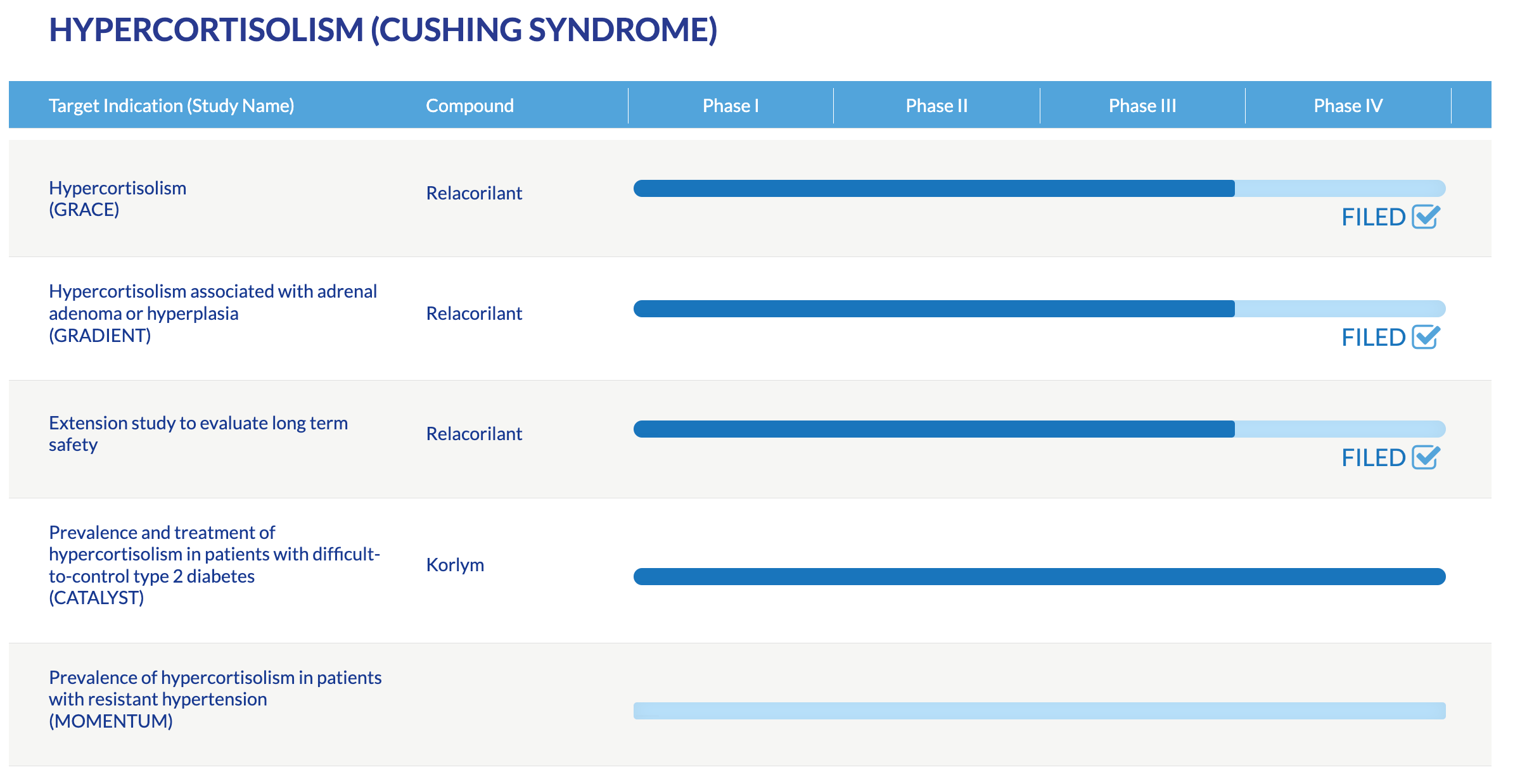
The company’s can be seen below:
What Biotech Investors Need to Know
Anchor expectations to the December 17, 2026 FDA decision for relacorilant in Cushing’s syndrome, not to Corcept’s broader cortisol-modulation pipeline. The key question is unusually narrow: whether the additional analyses requested by the FDA are enough to overturn a prior Complete Response Letter that explicitly asked for more evidence of effectiveness.
The strongest part of the application is GRACE. The pivotal Phase 3 trial met its primary endpoint in a randomized withdrawal phase, with patients switched to placebo significantly more likely to lose blood-pressure control than patients who remained on relacorilant. The odds ratio was 0.17 with p=0.02. Patients also showed improvements in hyperglycemia and multiple other manifestations of excess cortisol.
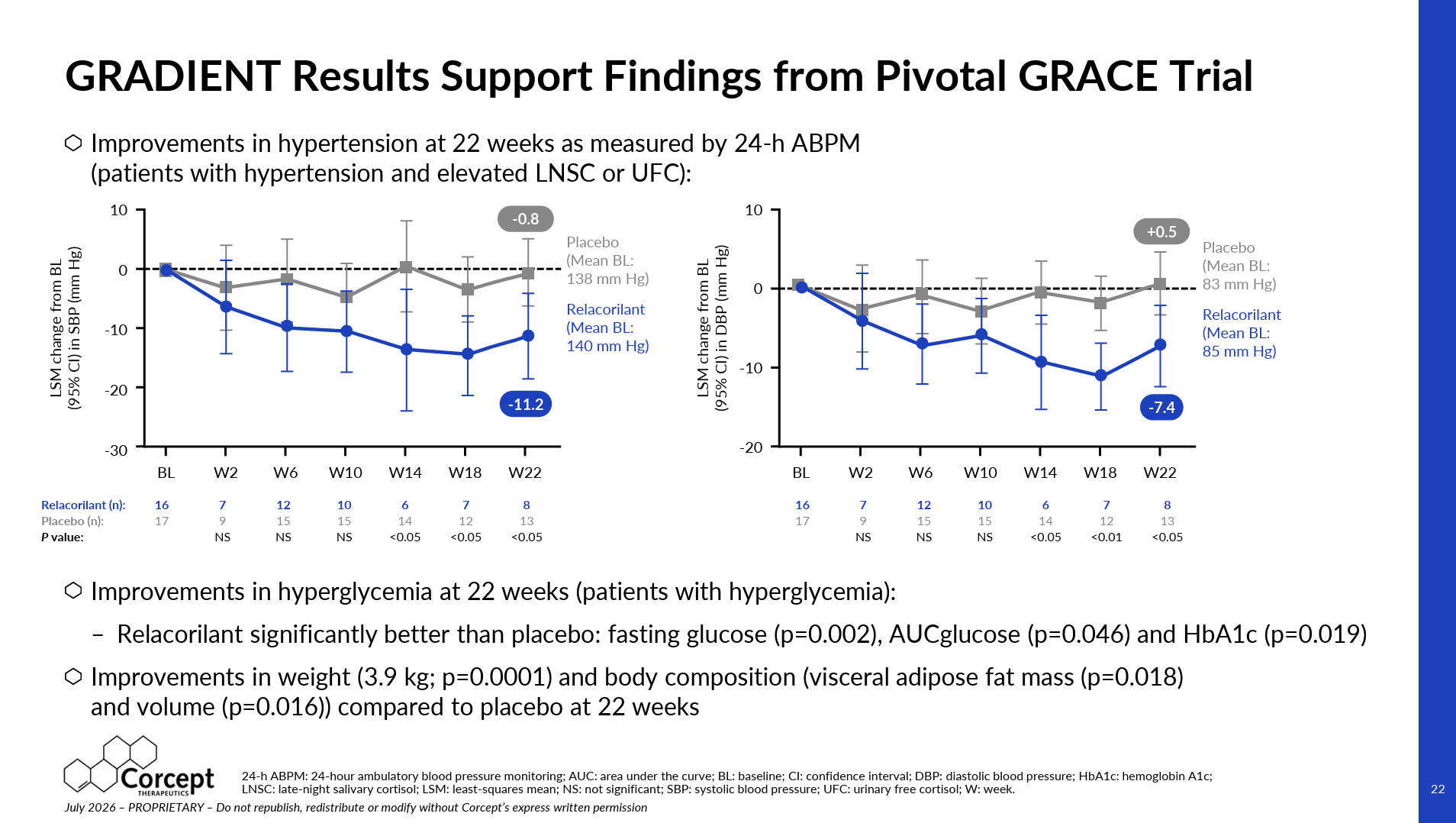
The main source of regulatory uncertainty is GRADIENT. The study was fully randomized and placebo-controlled, but its hypertension primary endpoint was mixed. Relacorilant produced a statistically significant 6.6 mm Hg reduction in systolic blood pressure from baseline, while placebo produced a 2.1 mm Hg reduction; however, the direct treatment-versus-placebo comparison was not statistically significant. Several secondary metabolic measures were stronger, including significant placebo-adjusted improvements in fasting glucose, HbA1c and body weight.
That distinction matters because the FDA already evaluated the full program once. The December 2025 CRL did not say GRACE failed. It specifically acknowledged that GRACE met its primary endpoint and that GRADIENT provided confirmatory evidence, yet still concluded that additional evidence of effectiveness was necessary. Investors should therefore avoid reducing the catalyst to a simple “positive Phase 3 equals approval” setup.
The most important bullish signal is what happened after the CRL. The FDA asked Corcept to perform additional analyses of data already contained in the NDA rather than immediately requiring another pivotal study. Corcept reported a positive outcome from those analyses, resubmitted the NDA in June and received a six-month review with a December 17 PDUFA. That sequence suggests the agency believes the existing dataset is at least potentially capable of supporting approval if analyzed and presented appropriately.
The bear case is that no new randomized efficacy data were generated. The FDA has already seen the underlying patients, endpoints and treatment effects. If its original concern was that the magnitude or consistency of benefit was simply not persuasive enough, additional analyses may change the framing without changing the fundamental evidence.
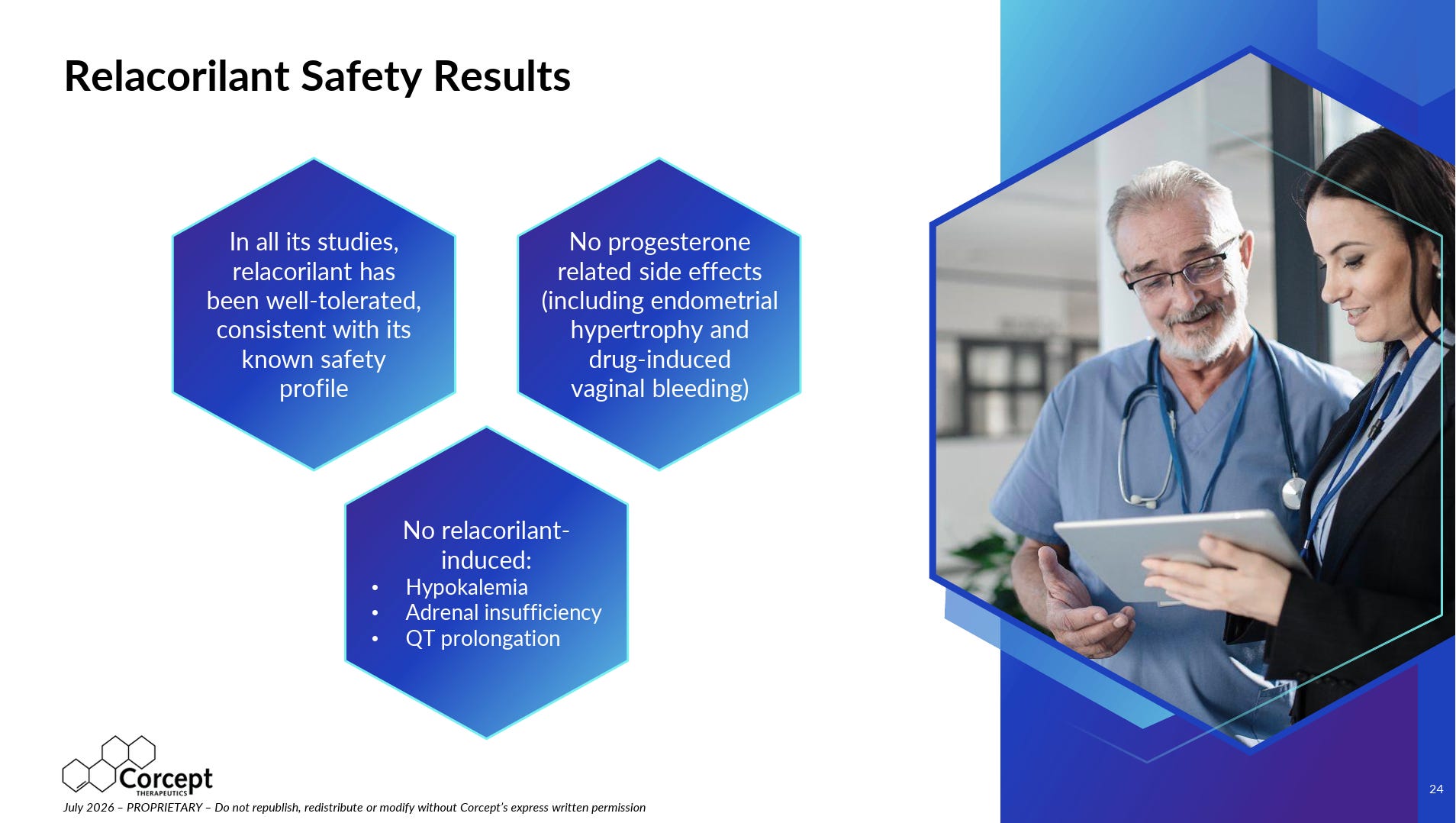
Relacorilant’s safety profile is a meaningful part of the bull case. Corcept reports that patients did not experience several important adverse effects associated with other cortisol-directed therapies, including relacorilant-induced hypokalemia, endometrial hypertrophy or related vaginal bleeding, adrenal insufficiency and QT prolongation. That could make a modest efficacy package more attractive if the FDA views the benefit as clinically meaningful.
Bottom line: this is a regulatory interpretation catalyst more than a mechanism or target-validation catalyst. Relacorilant has demonstrated biological and clinical activity, GRACE succeeded on its primary endpoint, and the FDA has already identified the exact weakness it wants addressed. The December decision will show whether Corcept’s reanalysis truly closes that gap or whether the Cushing’s program still needs materially new evidence.
Confidence in mechanism
Confidence in mechanism should be high. Cushing’s syndrome is fundamentally a disease of excessive cortisol activity, and relacorilant is designed to directly reduce that activity by selectively modulating the glucocorticoid receptor. The main uncertainty for the December PDUFA is therefore not whether glucocorticoid-receptor blockade can improve hypercortisolism, but whether relacorilant’s specific efficacy package is persuasive enough for FDA approval.
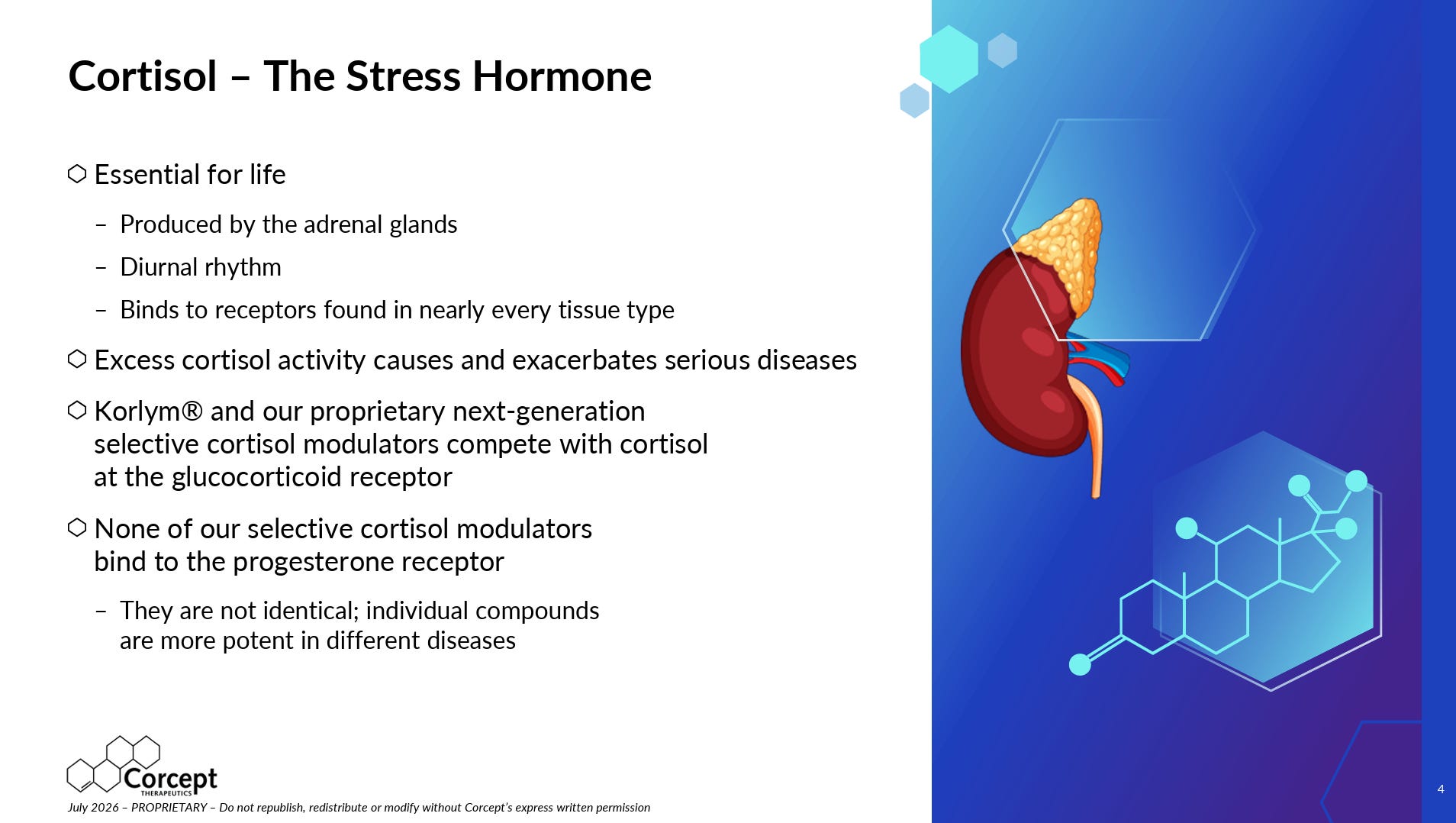
The target is directly tied to the biology of the disease. Cushing’s syndrome results from prolonged exposure to excessive cortisol activity, which drives hypertension, hyperglycemia, weight gain, muscle weakness and other complications. Blocking cortisol signaling at the glucocorticoid receptor therefore acts directly on the downstream driver of the disease.
The mechanism already has clinical validation in Cushing’s syndrome. Mifepristone, marketed by Corcept as Korlym, is an FDA-approved glucocorticoid-receptor antagonist for hyperglycemia secondary to endogenous Cushing’s syndrome. That substantially reduces target-level risk because the therapeutic concept of blocking cortisol action is already established.
Relacorilant is designed to preserve glucocorticoid-receptor activity while avoiding important off-target effects of mifepristone. It binds the glucocorticoid receptor without meaningful affinity for the progesterone receptor or other steroid hormone receptors, which is intended to avoid effects such as endometrial thickening and vaginal bleeding.
The clinical data support meaningful downstream cortisol modulation. In GRACE and earlier studies, relacorilant produced improvements across blood pressure, glycemic control, weight and other manifestations of hypercortisolism. Those effects are consistent with the expected consequences of reducing excessive cortisol signaling.
The safety profile strengthens the mechanistic thesis. Corcept reports that relacorilant does not meaningfully increase cortisol levels and has not produced the same pattern of drug-induced hypokalemia associated with mifepristone. That suggests selective receptor modulation may preserve efficacy while improving tolerability.
The FDA’s prior CRL does not appear to challenge the biological mechanism. The agency acknowledged that GRACE met its primary endpoint and that GRADIENT provided confirmatory evidence, but requested additional evidence of effectiveness. The regulatory disagreement is therefore about whether the magnitude and consistency of benefit are sufficient, not whether glucocorticoid-receptor modulation is pharmacologically credible.
The biggest remaining mechanism-level risk is clinical effect size rather than target validity. A drug can engage a validated pathway yet still produce a benefit that is too modest or inconsistent for approval. That is the central distinction investors should keep in mind going into December.
What upgrades confidence: consistent benefit across hypertension, glycemic control, body weight and other cortisol-driven manifestations; continued long-term response; and evidence that relacorilant’s selectivity translates into a meaningfully better therapeutic window than older glucocorticoid-receptor antagonists.
Until then, the mechanism should be viewed as one of the strongest parts of the CORT thesis. Excess cortisol activity is the core disease biology, glucocorticoid-receptor antagonism is already clinically validated, and relacorilant has demonstrated effects consistent with that mechanism.
For the December 17 PDUFA, mechanism risk is low relative to regulatory risk. The question is not whether blocking cortisol signaling can work in Cushing’s syndrome. It is whether relacorilant’s particular dataset demonstrates enough clinically meaningful benefit for the FDA to approve it after the prior CRL.
PK, exposure, and distribution
PK, exposure, and distribution should be viewed as supportive but not fully de-risked. Relacorilant has an established human pharmacokinetic profile from its approved oncology use, while the Cushing’s program used once-daily dosing titrated from 100 mg to as high as 400 mg based on response and tolerability. The main question is not whether the drug reaches systemic circulation, but whether exposure across that dose range consistently produces enough glucocorticoid-receptor blockade to control disease manifestations without creating an unfavorable safety trade-off.
The half-life is compatible with once-daily dosing. The FDA-approved prescribing information reports a terminal half-life of approximately 27 hours, supporting sustained systemic exposure across a daily dosing interval.
GRACE used a response-guided titration strategy rather than a single fixed dose. Patients started at 100 mg once daily and could escalate in 100 mg increments to a target of 400 mg once daily based on clinical response and tolerability. Just over half of enrolled patients reached 400 mg as their highest dose.
Relacorilant distributes extensively beyond the plasma compartment. The approved label reports an apparent volume of distribution of approximately 2,490 L after a single 150 mg dose, while plasma protein binding is greater than 99%. That is consistent with broad tissue distribution, although it does not establish glucocorticoid-receptor occupancy in specific target tissues.
Food has a meaningful effect on exposure. In the approved prescribing information, a low-fat meal increased AUC approximately twofold and a high-fat meal increased AUC approximately 2.4-fold compared with fasting. That makes administration conditions relevant when interpreting exposure and could matter for consistent chronic dosing.
The exposure-response relationship is not fully characterized. The FDA label explicitly states that relacorilant exposure-response relationships and the time course of pharmacodynamic response have not been fully defined. This is one of the main limitations of the PK package because the Cushing’s application relies on clinical signs and symptoms rather than a simple biochemical exposure target.
The clinical dose range nevertheless produced durable downstream effects. In GRACE, patients showed sustained improvements in blood pressure, glycemic measures, weight and other signs of hypercortisolism across the titration period, supporting that the selected exposure range is pharmacologically active.
The long-term extension provides additional reassurance on chronic exposure. Patients from GRACE, GRADIENT and earlier studies received relacorilant for prolonged periods, with treatment durations extending for years and continued cardiometabolic benefit reported. That reduces concern that efficacy disappears with chronic dosing or that accumulation creates an obvious new tolerability problem.
Drug-interaction risk remains relevant because relacorilant is metabolically active through CYP pathways. The approved label includes clinically important interaction warnings involving CYP3A and CYP2C8. That does not undermine the Cushing’s thesis, but it adds practical complexity to chronic use in patients who often take multiple cardiovascular and metabolic medications.
Overall, the PK package supports once-daily chronic administration and demonstrates substantial systemic exposure, broad distribution and a half-life long enough to maintain drug levels between doses. The main limitation is that the public data do not provide a clean quantitative exposure-to-receptor-occupancy-to-clinical-response relationship in Cushing’s syndrome.
What upgrades confidence: a clearer exposure-response analysis across the 100-400 mg Cushing’s dose range, better characterization of whether higher exposure produces incrementally greater clinical benefit, and evidence that administration conditions and drug interactions do not create clinically meaningful variability.
For the December 17 PDUFA, PK is not the central regulatory risk. Relacorilant reaches pharmacologically active exposure and has already produced durable clinical effects. The unresolved issue remains whether those effects are sufficiently consistent and persuasive to satisfy the FDA’s effectiveness standard after the prior CRL.
PD read-through
PD read-through should be viewed as strong at the clinical level. Relacorilant is intended to reduce the downstream consequences of excessive cortisol signaling rather than lower cortisol production itself, so the most relevant pharmacodynamic evidence is improvement across the cardiovascular, metabolic and functional manifestations of hypercortisolism.
The core PD chain is straightforward. Excess cortisol activates the glucocorticoid receptor → drives hypertension, hyperglycemia, weight gain, abnormal body composition and other manifestations of Cushing’s syndrome → relacorilant blocks glucocorticoid-receptor signaling → those downstream disease manifestations improve.
Blood-pressure improvement provides the clearest direct clinical PD signal. In the open-label portion of GRACE, patients with hypertension who entered randomized withdrawal had mean reductions of 12.6 mm Hg in systolic blood pressure and 8.3 mm Hg in diastolic blood pressure, both highly statistically significant.
The randomized withdrawal phase strengthens the causal interpretation. Patients who continued relacorilant were significantly more likely to maintain blood-pressure control than patients switched to placebo, with an odds ratio of 0.17 and p=0.02. That is important because it shows that the improvement was not simply regression to the mean or background variability.
Glycemic read-through is also consistent with the expected mechanism. In GRACE, patients with hyperglycemia who entered withdrawal showed improvements in HbA1c, fasting glucose and oral-glucose-tolerance measures during treatment. These are clinically relevant downstream consequences of reducing cortisol-driven insulin resistance.
Body composition and functional measures support a broader disease effect. Relacorilant-treated patients showed improvements in body weight, waist circumference, fat mass, lean mass, sit-to-stand performance, quality of life and cognitive assessments. That breadth is important because Cushing’s syndrome is a multisystem disease and a convincing PD profile should extend beyond a single blood-pressure endpoint.
GRADIENT provides additional placebo-controlled support, but the signal is uneven. Relacorilant significantly outperformed placebo on fasting glucose, HbA1c, weight and visceral fat measures. Blood-pressure improvement was directionally favorable, but the primary treatment-versus-placebo comparison was not statistically significant. That is the key reason the PD package is supportive rather than flawless.
The long-term extension supports durability. Patients treated for extended periods maintained or further improved cardiometabolic measures, with statistically significant reductions in systolic and diastolic blood pressure reported at 24 months. That argues against a short-lived pharmacodynamic effect.
The main PD limitation is the lack of a simple biochemical bridge. Relacorilant does not work by suppressing cortisol concentration, so there is no single hormone level that cleanly proves target engagement. The FDA therefore has to judge the consistency and clinical relevance of the downstream signs and symptoms rather than rely on a straightforward biomarker-response relationship.
Overall, the PD package is directionally strong and consistent with the expected consequences of glucocorticoid-receptor blockade. The clearest evidence comes from blood-pressure maintenance in GRACE, reinforced by improvements in glycemic control, body composition, functional measures and long-term cardiometabolic outcomes.
What upgrades confidence: continued consistency across multiple cortisol-driven manifestations, durable benefit with long-term treatment, and evidence that improvements persist across different Cushing’s etiologies rather than being concentrated in one subgroup.
For the December 17 PDUFA, PD is not the core weakness. Relacorilant has already shown a broad pattern of downstream clinical effects consistent with meaningful cortisol modulation. The regulatory question is whether those effects are sufficiently rigorous and consistent—particularly across the randomized datasets—to satisfy the FDA’s effectiveness standard after the prior CRL.
Clinical Trial Design
Confidence in the overall clinical program should be moderate-to-high, but the two Phase 3 studies answer different questions. GRACE is the pivotal efficacy study and used a randomized-withdrawal design after an open-label enrichment period, while GRADIENT was a fully randomized, double-blind, placebo-controlled study in patients with adrenal Cushing’s syndrome. Together, they provide meaningful evidence, but the structure of GRACE creates interpretive strengths and limitations that are central to the FDA debate.
GRACE used a randomized-withdrawal design rather than conventional parallel-group randomization from baseline. All 152 enrolled patients first received relacorilant for 22 weeks. Only patients who met prespecified response criteria for hypertension and/or hyperglycemia entered the randomized, double-blind withdrawal phase and were assigned to continue relacorilant or switch to placebo for 12 weeks.
The withdrawal design is well suited to testing maintenance of response. The key question was whether patients who improved on relacorilant would lose that benefit after the drug was removed. The primary endpoint was maintenance of blood-pressure control, and patients switched to placebo were significantly more likely to lose that response.
The design also enriches for responders. Because only patients who demonstrated prespecified improvement during open-label treatment entered the randomized phase, GRACE does not estimate the average treatment effect in an unselected Cushing’s population as cleanly as a conventional placebo-controlled trial from baseline would.
The primary endpoint was clinically meaningful but narrow. Maintenance of blood-pressure control is relevant in Cushing’s syndrome, but the disease affects multiple systems. Corcept therefore relies heavily on the broader pattern of improvements in glycemic control, weight, body composition, functional measures and quality of life to support the total benefit profile.
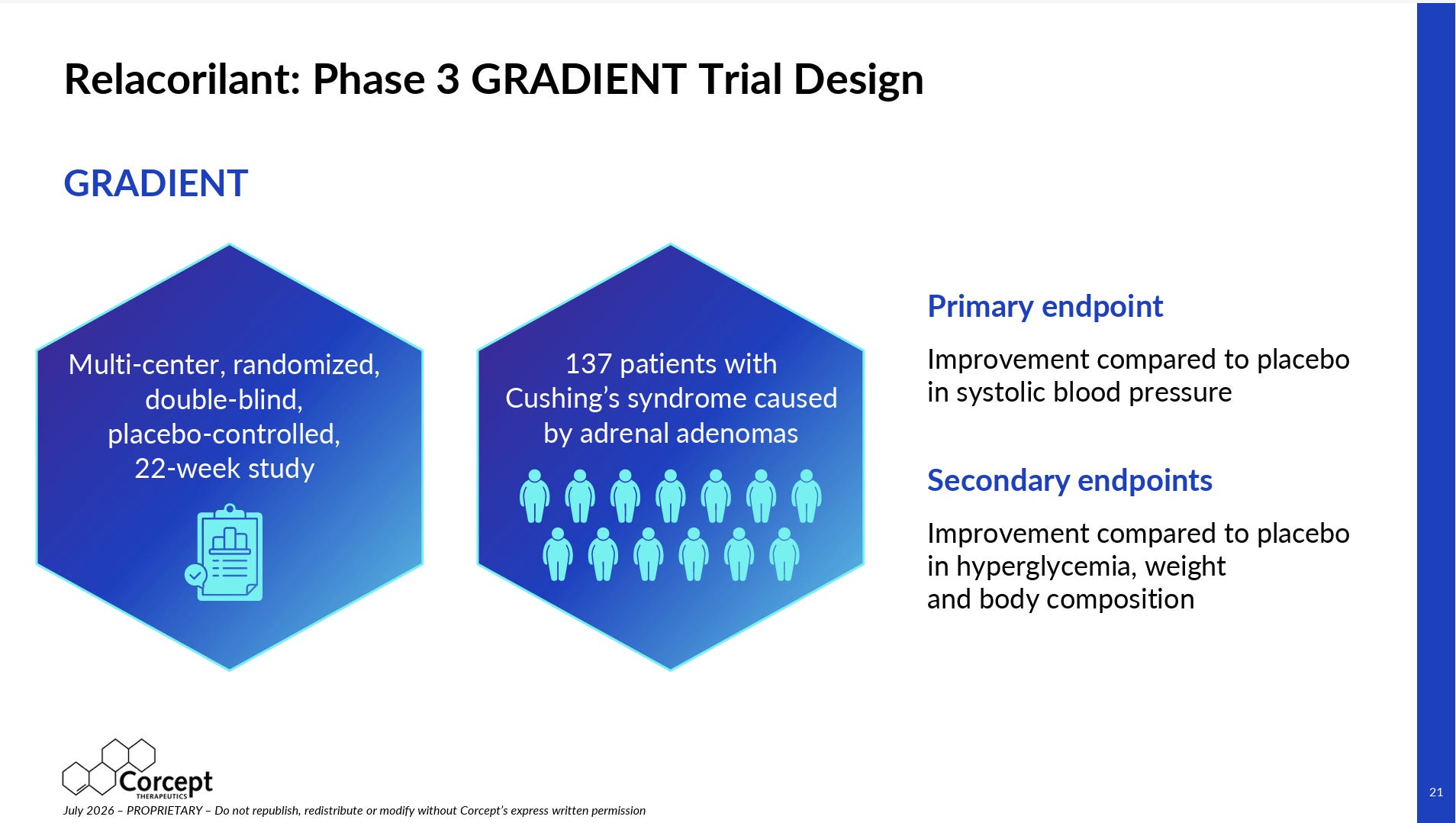
GRADIENT provides the cleaner placebo-controlled test. The study randomized 137 patients with adrenal Cushing’s syndrome in a double-blind, placebo-controlled 22-week trial. The primary endpoint was improvement in systolic blood pressure versus placebo, with secondary endpoints assessing hyperglycemia, weight and body composition.
GRADIENT’s primary blood-pressure comparison was the main weakness. Relacorilant produced meaningful within-group blood-pressure improvement, but the direct treatment-versus-placebo primary comparison was not statistically significant. Several metabolic secondary endpoints were positive, which made the study supportive but not a clean replication of GRACE.
The two-study package therefore contains both complementary and conflicting features. GRACE provides a statistically successful randomized-withdrawal result in a responder-enriched population. GRADIENT provides conventional randomized placebo-controlled evidence, but its primary endpoint was mixed. The FDA has to decide whether those two pieces together constitute sufficient evidence of effectiveness.
The long-term extension adds durability but not independent randomized confirmation. Patients from GRACE, GRADIENT and earlier studies continued relacorilant for prolonged periods and maintained or further improved cardiometabolic outcomes. That supports persistence of effect, but it does not replace the evidentiary value of a second unequivocally positive controlled trial.
The prior CRL shows that trial design and evidentiary integration matter more than nominal success alone. The FDA explicitly acknowledged that GRACE met its primary endpoint and that GRADIENT provided confirmatory evidence, yet still requested additional evidence of effectiveness. That means the regulatory issue is not whether the studies were valid, but whether their combined structure and results are strong enough to support approval.
Overall, the clinical program is credible but not perfectly clean. GRACE produced a statistically successful randomized-withdrawal result, while GRADIENT supplied conventional placebo-controlled support with a mixed primary endpoint. That leaves the FDA with a genuine judgment call about whether the totality of evidence is sufficiently rigorous and consistent.
What upgrades confidence: evidence that the FDA accepts the responder-enriched withdrawal design as adequately persuasive, successful reanalysis that better integrates GRACE and GRADIENT, and continued consistency across blood pressure, glycemic and other disease manifestations.
For the December 17 PDUFA, trial design is one of the most important parts of the thesis. The first CRL already established that a positive GRACE endpoint plus supportive GRADIENT data were not automatically enough. The resubmission must show that the existing study architecture and additional analyses together satisfy the agency’s effectiveness standard.
Competition Check
Surgery remains the preferred first-line treatment
The main competitor to any chronic medical therapy in Cushing’s syndrome is still successful removal of the underlying tumor. Surgery is generally preferred when the source can be identified and resected, but many patients are not cured, are not surgical candidates or eventually recur. Relacorilant therefore competes primarily in the persistent or medically managed disease setting rather than replacing surgery.
The most direct pharmacologic benchmark is Korlym
Corcept already markets mifepristone as Korlym for hyperglycemia secondary to endogenous Cushing’s syndrome in patients with diabetes or glucose intolerance who cannot undergo successful surgery. Korlym validates glucocorticoid-receptor antagonism as a treatment strategy, but its progesterone-receptor activity creates important limitations, including endometrial changes, vaginal bleeding and a boxed warning related to pregnancy termination.
Relacorilant is designed to preserve glucocorticoid-receptor antagonism without meaningful progesterone-receptor activity. If approved, that selectivity could make it easier to use in a broader chronic-treatment population and is one of the clearest potential commercial advantages over Korlym.
Steroidogenesis inhibitors provide a different way to control the disease
Osilodrostat, marketed as Isturisa, is approved for endogenous hypercortisolemia in adults with Cushing’s syndrome when surgery is not an option or has not been curative. It reduces cortisol production rather than blocking cortisol at the receptor and therefore offers physicians a mechanistically different treatment option.
The trade-off is that lowering cortisol synthesis can produce hypocortisolism or adrenal insufficiency and requires biochemical monitoring and dose titration. Isturisa also carries warnings around QT prolongation and electrolyte abnormalities. Relacorilant’s potential advantage is that it modulates cortisol action rather than suppressing cortisol production, which could simplify some aspects of disease management if efficacy is sufficiently strong.
Recorlev raises a similar efficacy-versus-monitoring trade-off
Levoketoconazole, marketed as Recorlev, is also approved for endogenous hypercortisolemia in adults with Cushing’s syndrome when surgery is not possible or not curative. Like Isturisa, it lowers cortisol synthesis rather than blocking the receptor.
Its label includes a boxed warning for hepatotoxicity and QT prolongation, with ongoing liver and cardiac monitoring required. That creates a meaningful tolerability and monitoring burden in a population that often requires long-term treatment.
Relacorilant’s strongest commercial argument is its therapeutic window
The competitive thesis is not that relacorilant is the only drug capable of improving Cushing’s syndrome. Several approved therapies already address excess cortisol through different mechanisms. The more compelling argument is that relacorilant may combine clinically meaningful control of hypertension, hyperglycemia, weight and other disease manifestations with a cleaner safety profile than older glucocorticoid-receptor antagonists and some cortisol-synthesis inhibitors.
Corcept reports no progesterone-related adverse effects, relacorilant-induced hypokalemia, adrenal insufficiency or QT prolongation across its clinical studies. If that profile is maintained in real-world use, it could become a meaningful differentiator.
The broad proposed Cushing’s population matters commercially
Korlym’s U.S. indication is limited to control of hyperglycemia in patients with endogenous Cushing’s syndrome who have type 2 diabetes or glucose intolerance. Relacorilant has been developed across a broader population with hypertension, hyperglycemia or both, which could support a wider treatment opportunity if the final FDA label reflects the breadth of the clinical program.
That potential label advantage should not be assumed before approval. The exact wording of the indication could materially affect how relacorilant competes with Korlym and cortisol-synthesis inhibitors.
There is no clean head-to-head efficacy comparison
Relacorilant has not been directly compared with Korlym, Isturisa or Recorlev in a randomized trial. Differences in study populations, endpoints and trial designs make cross-trial response comparisons unreliable. The commercial differentiation case therefore rests more on mechanism, tolerability, monitoring burden and eventual label breadth than on evidence that relacorilant is definitively more efficacious.
Approval could strengthen Corcept’s existing endocrine franchise
Corcept is not entering the Cushing’s market from scratch. It already has an established endocrinology commercial organization built around Korlym, including specialist relationships, patient support infrastructure and disease awareness programs. That could allow relacorilant to launch into an existing prescriber network rather than requiring a new commercial buildout.
Overall, relacorilant would enter a competitive but fragmented treatment market. Surgery remains preferred when curative, while Korlym, Isturisa and Recorlev each offer effective medical approaches with meaningful limitations. Relacorilant’s opportunity is to become a broadly usable chronic therapy by combining validated glucocorticoid-receptor biology with a cleaner safety and monitoring profile.
The competitive question is therefore not whether physicians already have ways to treat Cushing’s syndrome. They do. The question is whether relacorilant provides enough efficacy with fewer practical liabilities to become a preferred long-term medical option. That makes the eventual FDA label and the agency’s assessment of benefit-risk almost as important commercially as the binary approval decision itself.
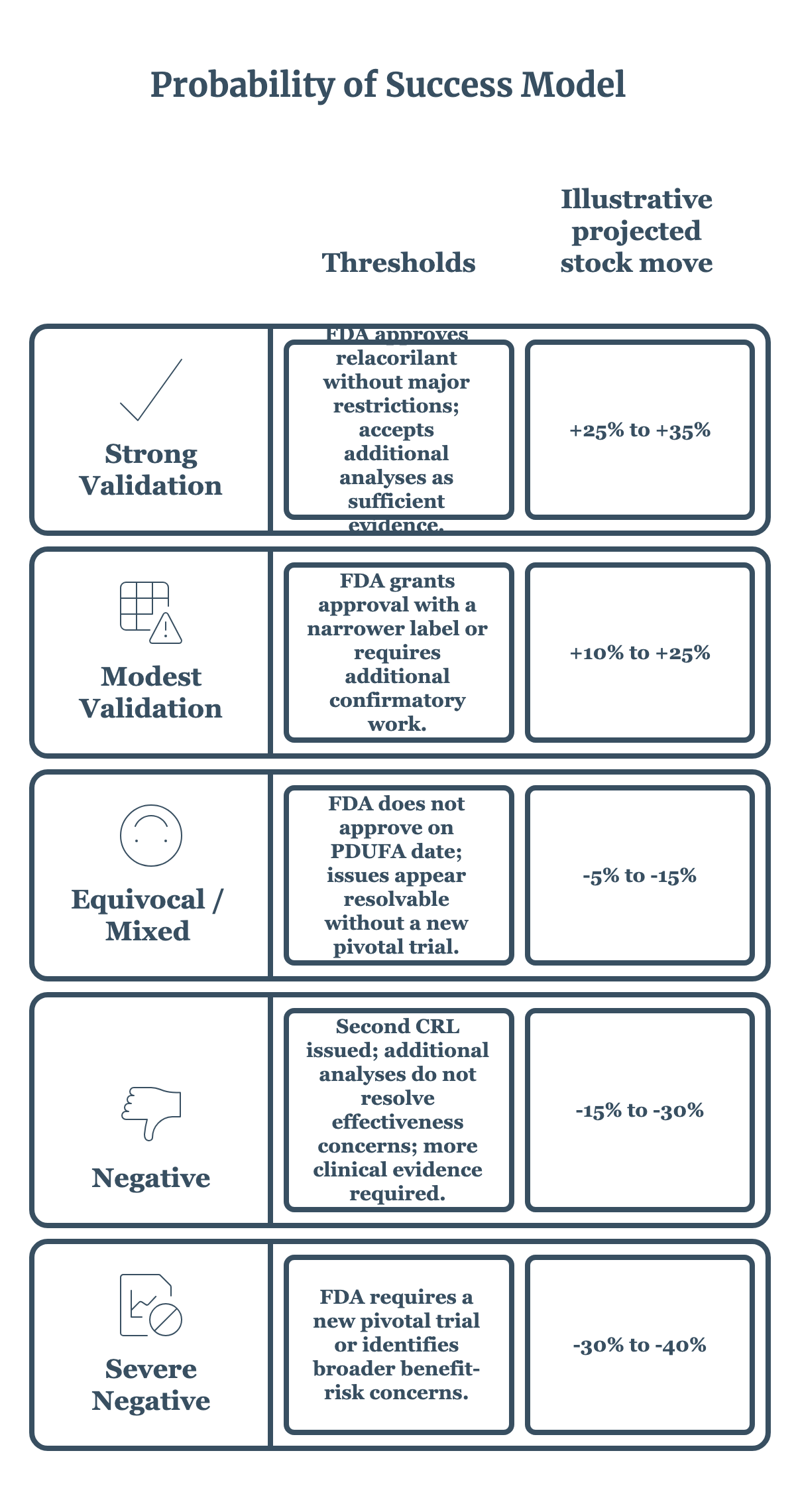
Probability of Success Model
Strong Validation: clean approval with a broad Cushing’s syndrome label
Thresholds:
The FDA approves relacorilant on December 17 without a major restriction that materially narrows the commercial opportunity. The agency accepts the additional analyses requested after the first CRL and concludes that GRACE, GRADIENT, the long-term extension and the reanalysis together provide sufficient evidence of effectiveness.
This would be the strongest possible validation of Corcept’s regulatory thesis. It would show that the original CRL reflected an evidentiary presentation or analysis problem that could be resolved without another pivotal trial, while also positioning relacorilant as a potentially broader and cleaner successor to Korlym.
Illustrative projected stock move: +25% to +35%
Modest Validation: approval with a narrower label or meaningful post-marketing requirements
Thresholds:
The FDA grants approval, but the label is narrower than the broad Cushing’s population Corcept has pursued, or the agency requires additional confirmatory work after launch. The approval could emphasize a more specific symptom profile, patient subgroup or treatment setting where the evidence is strongest.
This would still preserve substantial value because the central regulatory hurdle is cleared and relacorilant reaches the market. However, it would reduce the commercial breadth of the initial opportunity and suggest the FDA remains cautious about the consistency of the total efficacy package.
Illustrative projected stock move: +10% to +25%
Equivocal / Mixed: delay or additional information request without a clear efficacy rejection
Thresholds:
The FDA does not approve relacorilant on the PDUFA date, but the issue appears potentially resolvable without a new pivotal trial. This could include additional requests for analysis, labeling negotiation, a short review extension, or a manufacturing or administrative issue that does not fundamentally challenge the efficacy package.
This outcome would leave the thesis unresolved rather than broken. The stock reaction would depend heavily on whether investors view the delay as procedural or as a sign that the FDA still has substantive concerns about effectiveness.
Illustrative projected stock move: -5% to -15%
Negative: second Complete Response Letter requiring materially more evidence of effectiveness
Thresholds:
The FDA issues another CRL because the additional analyses do not adequately resolve the effectiveness concerns identified in the first review. The agency asks Corcept for substantially more clinical evidence before approval can be reconsidered, potentially including additional controlled data.
This would directly validate the central bear case. It would show that the problem was not simply how the original data were analyzed or presented, but that the existing GRACE and GRADIENT package remains insufficient for approval.
Illustrative projected stock move: -15% to -30%
Severe Negative: new pivotal trial required or broader benefit-risk concerns emerge
Thresholds:
The FDA concludes that the existing dataset cannot support approval and that another pivotal trial or similarly substantial clinical program is necessary. A new safety, manufacturing or benefit-risk issue that extends beyond the original efficacy concern would make the outcome even more damaging.
This would shift the interpretation from “the first CRL may be analytically resolvable” to a more fundamental conclusion that relacorilant’s Cushing’s program requires materially new evidence. The impact would extend beyond the immediate delay by reducing confidence in the size and timing of the endocrine franchise opportunity.
Illustrative projected stock move: -30% to -40%
This catalyst is ultimately about whether Corcept successfully answered the FDA’s prior effectiveness objection without generating a new pivotal dataset. The clean bull outcome is not simply approval. It is an approval broad enough to demonstrate that the agency accepts the existing clinical package after the requested reanalysis.
The distinction between a clean approval and a constrained approval is important. A narrower label or substantial post-marketing requirement would still preserve meaningful value, but it would imply that the FDA remains less convinced by the totality of the evidence than Corcept’s broader thesis suggests.
The scenario ranges above are illustrative stock-price reactions rather than validated probability-weighted targets. Based on the straddle you provided, the market is pricing roughly +32% upside and -29% downside to the expiration breakevens, or approximately a 60% total catalyst range using the convention applied throughout this report.
The clean binary is therefore not “does relacorilant work?” The mechanism and clinical activity are already well established. The question is whether the FDA believes Corcept’s additional analyses are enough to convert a prior CRL into a durable approval without requiring materially new efficacy data.
Methodology & Base Assumptions
This framework starts with a base probability for a resubmitted NDA after a Complete Response Letter and then adjusts that prior for the unusually specific relacorilant setup. The goal is not to produce a mathematically precise FDA probability. It is to make the major positives and negatives explicit and avoid treating either the successful GRACE endpoint or the prior CRL as dispositive on its own.
Mechanism / modality adjustment
Credit: Glucocorticoid-receptor antagonism is already clinically validated in Cushing’s syndrome through mifepristone, and relacorilant has demonstrated broad clinical effects consistent with reduced cortisol signaling.
Penalty: Mechanistic validity does not resolve the FDA’s concern. The prior CRL was specifically about whether relacorilant’s clinical evidence demonstrates enough effectiveness for approval.
Pivotal efficacy adjustment
Credit: GRACE met its prespecified primary endpoint in the randomized-withdrawal phase. Patients continuing relacorilant were significantly more likely to maintain blood-pressure control than patients switched to placebo, with an odds ratio of 0.17 and p=0.02.
Penalty: GRACE used an open-label enrichment period before randomization, meaning the controlled phase included patients who had already demonstrated a response. That makes the result clinically persuasive but less conventional than a clean parallel-group placebo-controlled success from baseline.
Confirmatory evidence adjustment
Credit: GRADIENT provides an independent randomized, double-blind, placebo-controlled dataset and showed significant placebo-adjusted improvements in several metabolic measures, including fasting glucose, HbA1c, weight and visceral fat.
Penalty: The study’s primary systolic blood-pressure comparison versus placebo was not statistically significant. This is the most important weakness in the confirmatory package and likely contributed to the FDA’s unwillingness to approve the original NDA.
Prior CRL adjustment
Credit: The FDA explicitly acknowledged that GRACE met its primary endpoint and that GRADIENT provided confirmatory evidence. The rejection therefore did not amount to a finding that the program lacked any efficacy signal.
Penalty: The agency still concluded that it could not make a favorable benefit-risk assessment without additional evidence of effectiveness. A prior efficacy-related CRL deserves a substantial negative weighting because the FDA has already reviewed the core dataset once and declined approval.
Resubmission-path adjustment
Credit: After the CRL, the FDA asked Corcept to conduct additional analyses of data already included in the NDA rather than immediately requiring a new pivotal trial. Corcept reported a positive outcome from those analyses and was able to resubmit the application for a six-month review. That is one of the strongest bullish signals in the setup.
Penalty: No new randomized efficacy data were generated. If the original problem reflects a fundamental weakness in magnitude or consistency of benefit rather than an analytical issue, reanalysis of the same patients may not be sufficient.
Safety / benefit-risk adjustment
Credit: Relacorilant has been generally well tolerated and lacks several liabilities associated with existing cortisol-directed therapies, including progesterone-receptor effects, relacorilant-induced hypokalemia, adrenal insufficiency and QT prolongation. A cleaner safety profile can make a less-than-perfect efficacy package more attractive on benefit-risk grounds.
Penalty: Safety cannot compensate indefinitely for insufficient evidence of effectiveness. The FDA’s prior CRL makes clear that tolerability alone will not carry the application.
Long-term durability adjustment
Credit: The long-term extension showed durable cardiometabolic benefit, with patients maintaining or further improving blood pressure and other disease manifestations during prolonged treatment.
Penalty: The extension is supportive rather than independently confirmatory because it is not a new randomized placebo-controlled trial.
Regulatory execution adjustment
Credit: Corcept is an established commercial company with an existing Cushing’s franchise, substantial regulatory experience and a second FDA approval for relacorilant in oncology. The molecule itself is therefore de-risked from a manufacturing and basic safety standpoint.
Penalty: The Cushing’s indication remains a separate efficacy decision. Prior approval of relacorilant in ovarian cancer should not be treated as evidence that the endocrine NDA will be approved.
Blended regulatory prior
Taking these factors together:
Base probability of approval on the current review cycle: ~55-65%
Central estimate: ~60%
Probability of CRL, delay or other non-approval outcome: ~40%
The estimate is above a coin flip because the FDA itself identified a potentially resolvable path using additional analyses of the existing NDA rather than requiring a new trial, and Corcept subsequently resubmitted after reporting a positive analytical outcome. It remains well below a high-confidence approval because the agency has already rejected essentially the same clinical program once for insufficient evidence of effectiveness.
Bayesian-style update factors
The probability should move materially based on any new information that changes one of the following:
FDA characterization of the reanalysis: whether the new analyses directly address the deficiency identified in the CRL.
Label scope: whether discussions suggest a broad Cushing’s indication or a narrower population where efficacy is strongest.
GRACE/GRADIENT integration: whether the analyses strengthen consistency between the responder-enriched pivotal study and the conventional placebo-controlled confirmatory study.
Durability: whether long-term extension data continue to support persistent benefit.
Safety: any newly identified issue that weakens relacorilant’s therapeutic-window advantage.
CMC / manufacturing: any late issue unrelated to efficacy that could delay approval.
Management language: whether Corcept continues to describe the FDA dialogue as constructive and the current dataset as sufficient, or begins emphasizing future evidence generation.
Posterior framework
Clean approval with a broad label: probability that relacorilant becomes a meaningful successor or complement to Korlym rises to approximately 85-90%.
Approval with a narrower label or substantial post-marketing requirement: probability of a viable commercial Cushing’s franchise remains approximately 70-80%, but the quality of the regulatory validation is lower.
Short delay or additional information request without a substantive efficacy rejection: probability of eventual approval remains approximately 55-70%, depending on the reason for the delay.
Second CRL requiring materially more effectiveness evidence: probability of near-term approval falls to approximately 20-35%, with recovery dependent on whether additional analyses or limited new data can resolve the issue.
Requirement for a new pivotal efficacy trial: probability of approval on the current clinical package falls below approximately 15-20%.
Tier calibration
The stock-move framework used throughout this report remains:
Strong Validation: +25% to +35%
Modest Validation: +10% to +25%
Equivocal / Mixed: -5% to -15%
Negative: -15% to -30%
Severe Negative: -30% to -40%
These ranges are intended to fit within the roughly +32% / -29% straddle framework currently observed around the event.
Downside tail shifters
The main factors that could push the downside beyond the central framework are:
A second CRL explicitly requiring a new pivotal trial.
FDA language indicating that the randomized-withdrawal design is insufficient as the principal efficacy evidence.
A label outcome materially narrower than the population investors expect.
A new safety or manufacturing issue.
Evidence that the additional analyses did not directly resolve the effectiveness deficiency cited in the first CRL.
This model deliberately avoids treating GRACE success, GRADIENT secondary endpoints, the FDA-requested reanalysis, relacorilant’s oncology approval, Corcept’s commercial infrastructure or the options market as independent proof of approval. Each changes the prior, but none determines the outcome alone.
The central 60% estimate reflects a regulatory package that has improved meaningfully since the first CRL but remains unresolved: a successful pivotal endpoint, supportive but imperfect confirmatory evidence, a favorable safety profile and an FDA-directed analytical path to resubmission on one side; a prior efficacy-related rejection and no new randomized patients on the other.
Technical Considerations — Cash Runway and Short Interest
Cash runway
Corcept enters the December PDUFA from a position of financial strength rather than dependency on the regulatory outcome.
Corcept reported $544.6 million of cash and investments as of June 30, 2026. That was up from $515.4 million at the end of the first quarter despite continued investment in relacorilant development, launch spending for Lifyorli and expansion of the broader pipeline.
The company is already revenue-generating and profitable. Second-quarter 2026 revenue was $256.1 million and net income was $43.0 million. Corcept also raised full-year 2026 revenue guidance to $1.1-$1.2 billion, meaning the December decision is not a financing-survival event.
A negative FDA decision would primarily affect valuation rather than liquidity. Corcept would still have Korlym revenue, a newly launched oncology franchise through Lifyorli and more than half a billion dollars of cash and investments based on the latest reported quarter.
A positive decision would strengthen an already established endocrine commercial platform. Corcept has an existing Cushing’s sales infrastructure built around Korlym, so approval would not require a large greenfield commercial buildout and could allow relacorilant to be launched into an existing specialist network.
The main balance-sheet risk is opportunity cost rather than runway. A second CRL could force additional clinical spending and delay the expected transition from Korlym toward relacorilant, but it would not place the company under immediate financing pressure.
Short interest
Short positioning is meaningful but not extreme.
Approximately 8.59 million CORT shares were sold short as of October 15, 2026. That represents about 10.0% of the public float.
Short interest has declined from earlier 2026 highs. The reported short position was above 11 million shares in April and has gradually moved lower, although it remains large enough to influence trading around a binary FDA event.
Days to cover is elevated at roughly 12.3. That is more notable than the raw short-float percentage because it suggests that covering the existing position could require many days of average trading volume if the PDUFA produces a strong upside move.
The bearish thesis has a clear fundamental anchor. Short sellers can point to the prior efficacy-related CRL, the mixed GRADIENT primary endpoint and the fact that the resubmission relies on additional analyses of the existing dataset rather than new randomized patients.
A clean approval could therefore create incremental upside through covering. The stock would reprice the removal of the regulatory overhang while some investors positioned for a second rejection could be forced to reduce or close short positions.
A second CRL would validate the central short thesis. If the FDA again cites insufficient evidence of effectiveness, the market would have direct confirmation that the reanalysis did not solve the core problem identified in the first review.
Overall, Corcept’s financial position materially reduces the importance of financing risk around the December catalyst. The company is profitable, has more than $500 million of cash and investments based on the latest reported quarter, and already operates two commercial franchises.
Short interest is large enough to amplify the event but not large enough to define it. The more important technical feature is the elevated days-to-cover figure. A clean approval could produce both a fundamental re-rating and forced covering, while a second efficacy-related CRL would reinforce an already well-defined bearish thesis.
WHAT THIS MEANS FOR YOU
Looking at the analysts results and price coverage, those who cover the company rate as a STRONG BUY with 4/4 buy ratings. Keep in mind analyst ratings ALWAYS must be taken with a grain of salt as bearish analysts do not have long careers for obvious reasons.
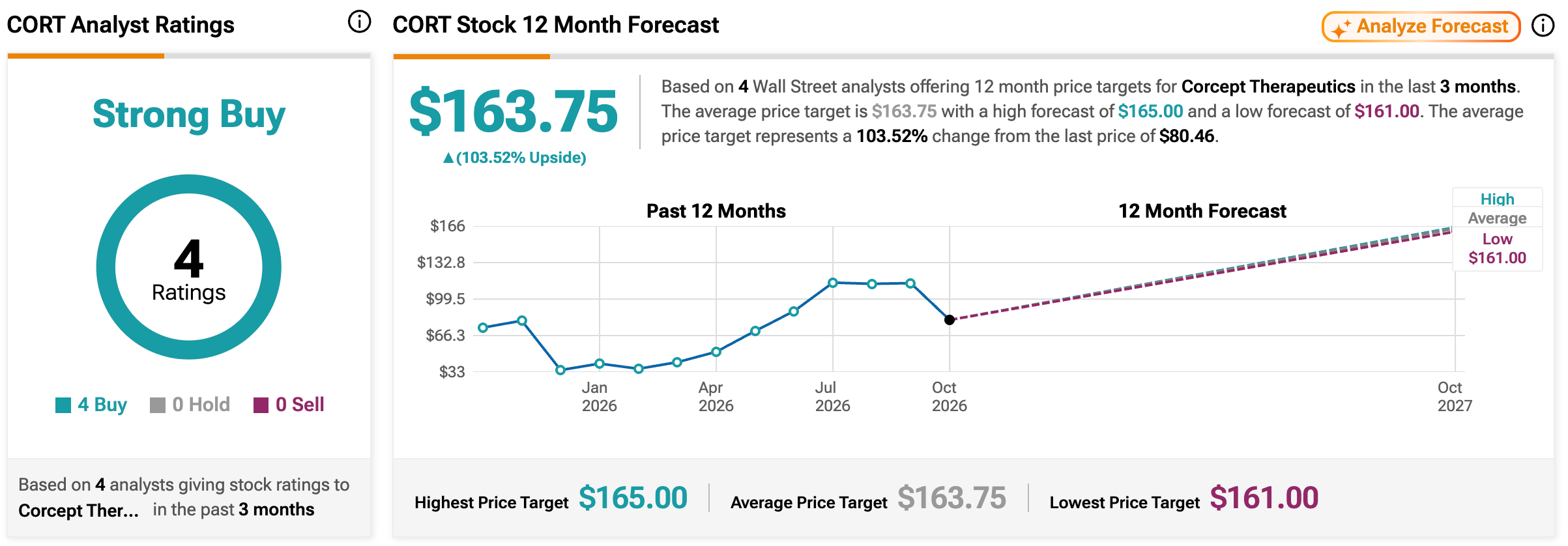
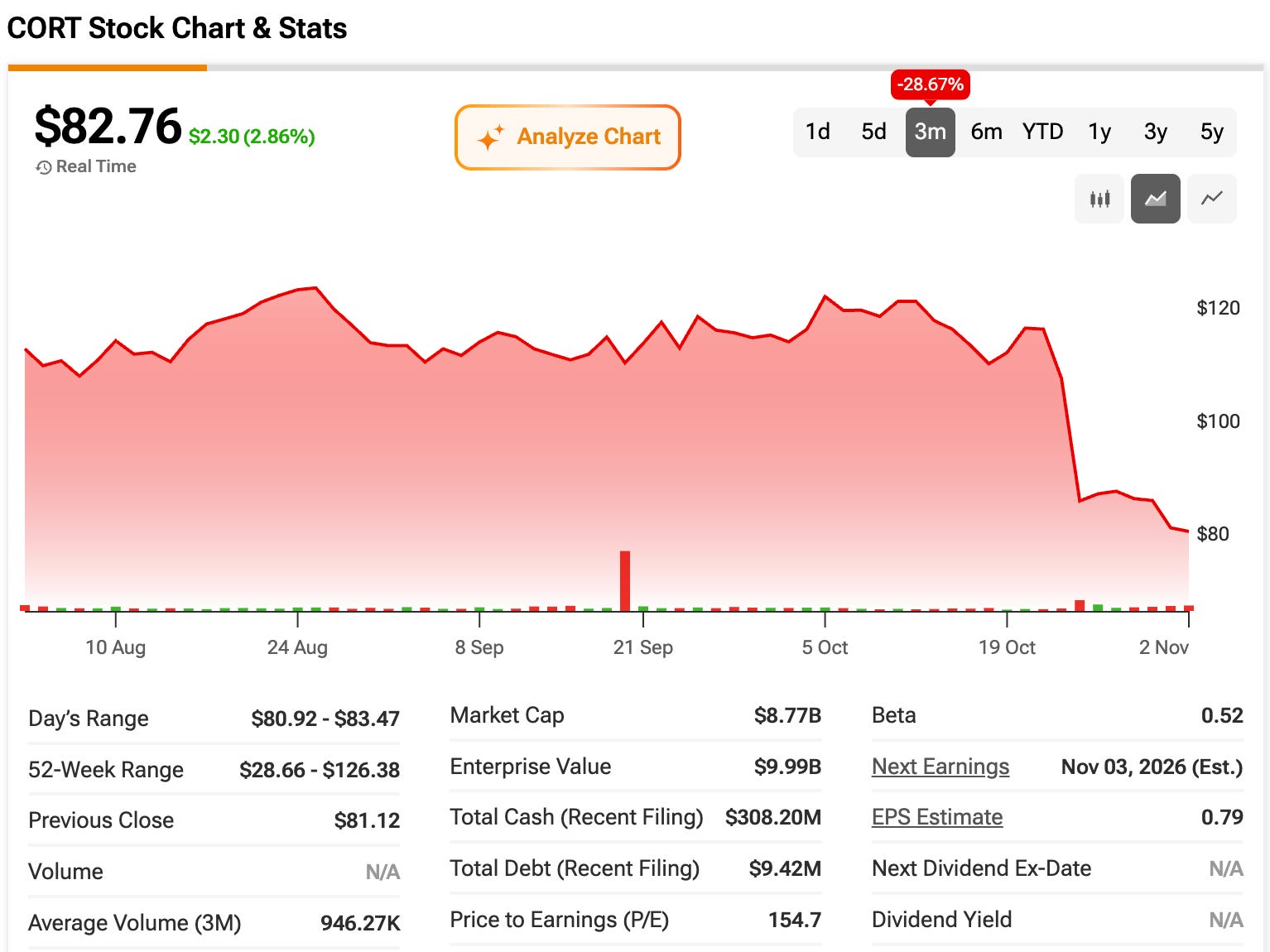
The stock is currently trading at $82.76. The lowest analyst estimate has this one trading at $161. The upside scenario is at $165 ~2x upside with downside potential over the longer timeframe.
If we look at options pricing, we can get a sense of the size of the move the traders are projecting. IF you do the math you get about a ~+30% move to the upside, and a -30% move to the downside. That would put the options projected price projections at ~$107.00 to the upside and ~$58.00 to the downside. Again, this is for a play on the short term catalyst which is a different timeframe from the 1yr analyst targets shown above.
Conclusion
Corcept Therapeutics enters the December 17, 2026 PDUFA with a clinically active drug, a successful pivotal endpoint and a regulatory history that makes the outcome unusually difficult to handicap. GRACE met its primary endpoint, GRADIENT provided supportive metabolic evidence and relacorilant has shown durable improvements across multiple manifestations of hypercortisolism. The problem is that the FDA has already reviewed essentially this program once and concluded that the evidence of effectiveness was not sufficient.
That makes this a regulatory-interpretation catalyst rather than a mechanism or target-validation catalyst. Glucocorticoid-receptor antagonism is already established in Cushing’s syndrome, relacorilant has demonstrated broad downstream clinical activity and the molecule itself is already FDA-approved in oncology. The December question is narrower: whether the additional analyses requested after the first CRL are enough to convert the same underlying clinical dataset into an approvable package.
The strongest bull argument is the path the FDA chose after the CRL. The agency asked Corcept for additional analyses of data already contained in the NDA rather than immediately requiring another pivotal trial. Corcept completed those analyses, described the outcome as positive and was able to resubmit the application for a new review cycle. That sequence suggests the deficiency may be analytically resolvable.
The bear argument is equally clear. No new randomized patients were generated, and GRADIENT’s primary blood-pressure comparison against placebo was not statistically significant. If the FDA’s original concern reflects a fundamental weakness in the magnitude or consistency of benefit rather than how the data were analyzed, the resubmission may still fall short.
A clean approval would do more than add another Cushing’s therapy. It would validate relacorilant as a potentially broader, better-tolerated successor or complement to Korlym and confirm that the first CRL could be resolved without another major trial. Corcept’s existing endocrine commercial infrastructure and strong balance sheet would allow the company to launch into an established specialist network.
A second CRL would be equally informative. If the agency again cites insufficient evidence of effectiveness, the interpretation would shift from “the first review may have been an analytical problem” toward “the existing clinical package is fundamentally not enough.” The key question would then become whether Corcept can salvage the program with additional follow-up and targeted analyses or whether materially new controlled data are required.
My central estimate remains approximately 60% probability of approval on the current review cycle and 40% probability of a delay, CRL or other non-approval outcome. That reflects the tension in the package: successful pivotal efficacy, supportive confirmatory data, favorable safety and an FDA-directed path to resubmission on one side; a prior efficacy-related rejection, mixed GRADIENT primary result and no new randomized dataset on the other.
The options market is pricing roughly +32% upside and -29% downside around the event, or approximately a 60% total catalyst range under the convention used throughout this report. That looks reasonable for a second-cycle FDA decision where the drug itself is substantially de-risked but the agency’s interpretation of the evidence remains unresolved.
The key question for CORT is not whether relacorilant works. It is whether the FDA believes Corcept has now proved that it works well enough.
That distinction is what makes the December catalyst compelling. A favorable decision would validate both the drug and the analytical path used to answer the first CRL. A second rejection would show that the effectiveness gap cannot be solved by reanalysis alone.
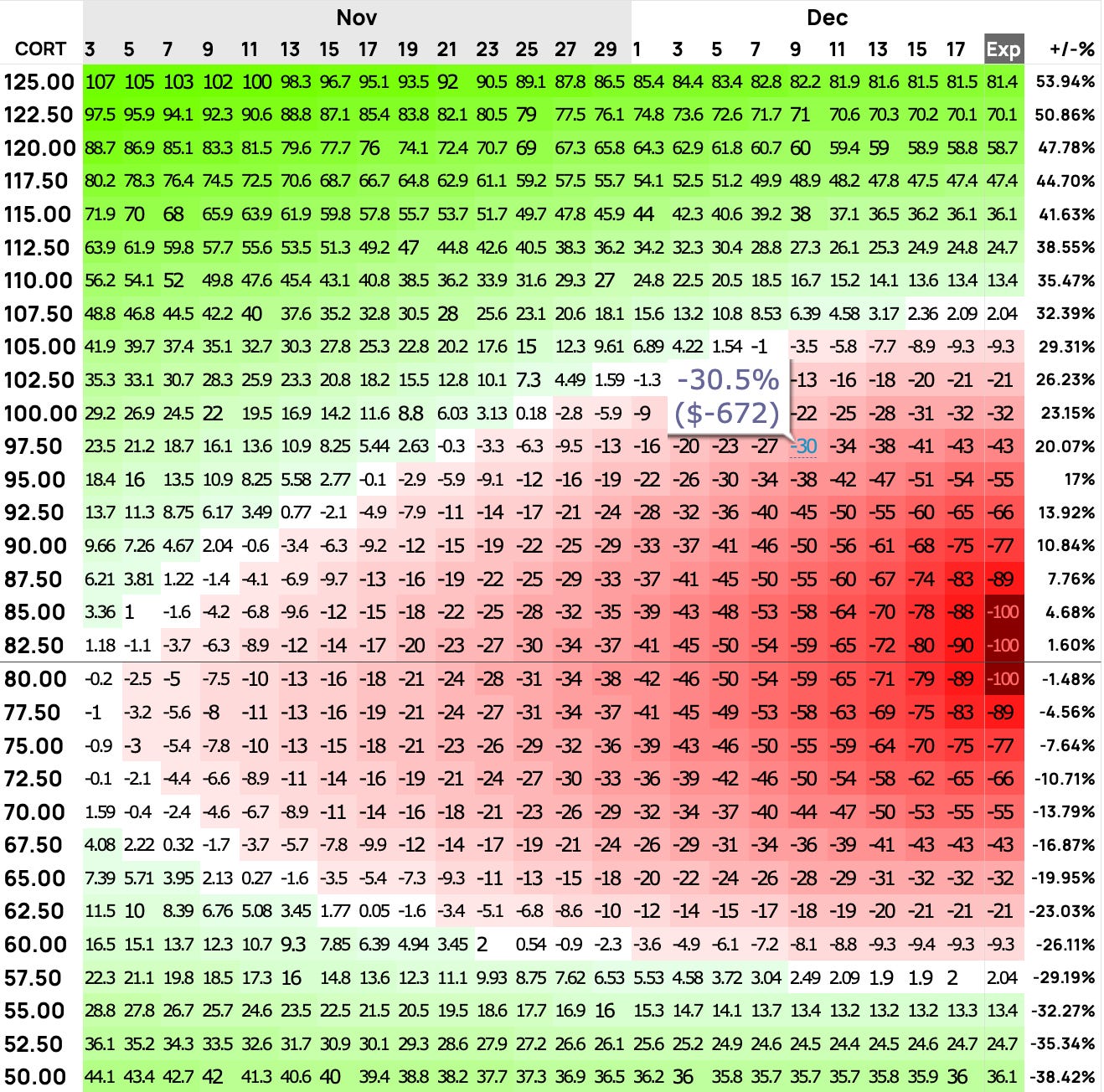
Options Market and Event Risk
The options market is pricing substantial event risk around Corcept Therapeutics’ December 17, 2026 FDA PDUFA for relacorilant in Cushing’s syndrome. Based on the straddle framework you provided, I am using an approximately 60% total catalyst range as the working benchmark, reflecting roughly +32% upside and -29% downside from the current share price. This is the convention used throughout this analysis: the upside and downside breakeven distances are added together to describe the total straddle range.
The catalyst is not a first-pass question of whether relacorilant has clinical activity. GRACE met its primary endpoint, GRADIENT provided supportive evidence across several metabolic measures, and the FDA has already reviewed the program once. The central uncertainty is whether Corcept’s additional analyses are sufficient to resolve the effectiveness deficiency that caused the prior Complete Response Letter.
Upside positioning is anchored to a clean approval. The strongest outcome would be FDA approval for a broad Cushing’s syndrome population without a major restriction that undermines the commercial opportunity. Under that scenario, the roughly +32% upside benchmark reflects both removal of the regulatory overhang and validation that the first CRL was analytically resolvable without another pivotal trial. Approval would also strengthen the transition from Korlym toward relacorilant within Corcept’s existing endocrine franchise.
A narrower approval would likely produce a smaller positive reaction. Approval limited to a specific subgroup, symptom profile or more restricted treatment setting would still create meaningful value, but it would imply that the FDA remains less convinced by the total efficacy package than the broad bull case assumes. Additional post-marketing requirements could also temper the initial re-rating.
Downside positioning is more dependent on the reason for non-approval. A short review extension, labeling delay or fixable CMC issue would be materially different from a second Complete Response Letter centered on insufficient evidence of effectiveness. The latter would directly validate the central bear thesis: that reanalysis of the existing data did not solve the core problem identified in the first review.
The roughly -29% downside benchmark should therefore be treated as a central event case rather than a maximum loss estimate. A second CRL that appears potentially resolvable with additional analyses or limited new data could trade closer to the middle of the downside range. A decision requiring a new pivotal trial or indicating that the existing clinical package cannot support approval could push the stock materially below the implied downside boundary.
Corcept’s financial position provides meaningful corporate downside support. The company is profitable, has more than $500 million of cash and investments based on the latest reported quarter, and already generates substantial revenue from Korlym and Lifyorli. A negative FDA decision would therefore reduce the value and timing of the endocrine franchise rather than create an immediate financing crisis.
Short interest is another potential amplifier. The short position is meaningful and days to cover is elevated, so a clean approval could create both a fundamental re-rating and forced covering. Conversely, a second efficacy-related CRL would validate a clear bearish thesis and could keep pressure on the shares after the initial event reaction.
The implied range and the probability of approval should be treated as separate questions. My central regulatory estimate remains approximately 60% probability of approval on the current review cycle and 40% probability of a delay, CRL or other non-approval outcome. The options market is pricing the magnitude of the possible move, not directly assigning those probabilities.
Bottom line: the roughly 60% total catalyst range looks reasonable for a second-cycle regulatory decision where the drug has established clinical activity but the FDA has already rejected the same underlying program once for insufficient evidence of effectiveness. The clean upside case is approval that confirms the requested reanalysis was enough. The clean downside case is a second CRL showing that the evidence gap is more fundamental than analytical.
The most important middle case is a constrained approval or fixable delay. That outcome would preserve meaningful value but would not provide the same regulatory validation as a broad approval, and the stock reaction could be substantially smaller than the headline straddle range.
As a reminder, if looking to go deeper into the topics we cover check out our website BowTiedBiotech.com, or DM us on twitter, or email us: bowtiedbiotech@gmail.com
We are now publishing 7x per week according to the following cadence:
Mondays: Stock Analysis & Biotech Catalysts
Tuesdays: Biotech hot topics (X-article)
Wednesdays: Podcast
Thursdays: Public & Private Biotech Markets
Fridays: Your Weekly Biotech Fix
Saturdays: Podcast
Sundays: Biotech Strategic Topics
We are also publishing unique content on X - be sure to follow up if you are not already @BowTiedBiotech. And to check-out the archive of our work on X you can find it on our website at: BowtiedBiotech.subtack.com/x-articles.
SUBSCRIBE TO PODCAST HERE:
DISCLAIMER
None of this is to be deemed legal or financial advice of any kind. All updates are sourced from publicly available disclosures. Insights are *opinions* written by an anonymous cartoon/scientist/investor.
TOP BOWTIEDBIOTECH NEWSLETTERS