

Hello Avatar! Welcome back for another week of biotech analysis. Today is Sunday, which means this is our Building Biotech newsletter that is focused on discussing biopharma strategy topics. This week we’re exploring how Beam Therapeutics quietly rewrote the financial physics of biotech. Instead of chasing the next clinical catalyst, Beam built a machine that turns technology into liquidity. Nearly a billion dollars of realized or committed capital, much of it through creative partnerships and spin-outs, has shown investors what a true platform looks like in motion. The takeaway is simple, when you design for modularity, you design for momentum.
We are now publishing 7x per week according to the following cadence:
Mondays: Stocks
Tuesdays: Biotech
Wednesdays: Podcast
Thursdays: Markets
Fridays: News
Saturdays: Podcast
Sundays: Strategy
We are also publishing unique content on X - be sure to follow up if you are not already @BowTiedBiotech. And to check-out the archive of our work on X you can find it on our website at: BowtiedBiotech.subtack.com/x-articles.
SUBSCRIBE TO PODCAST HERE:
Please help spread the work by subscribing and hitting the share button if you are enjoying our bi-weekly newsletters!

Enough shilling for the day, lots to cover this week, let's get started!
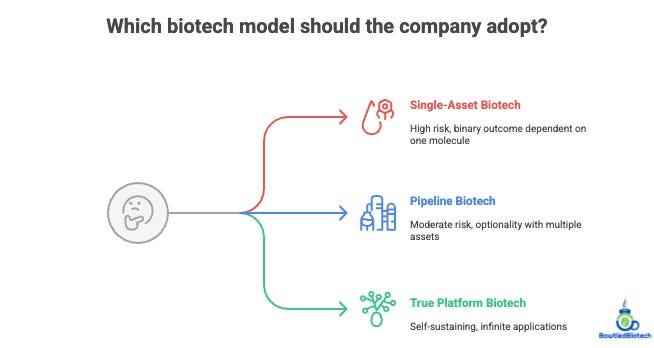
The Three Species of Biotech
Biotech companies tend to fall into three evolutionary classes, each with its own survival strategy.
The first is the single-asset biotech, the genetic equivalent of a mayfly. Its lifespan depends entirely on one molecule. The path is binary. Either the drug works and it is acquired, or the trial fails and the lights go out. These companies live by the sword of their data, and most die by it.
The second is the pipeline biotech, a more resilient creature. These firms use a shared discovery engine to create a handful of related assets, usually within one biology or modality. Their advantage is optionality. If one program stalls, others can carry the valuation forward. They can license non-core assets to generate cash or milestone payments. But the limitation is clear. The platform supports a finite number of experiments before it needs external funding again.
Then there is the true platform biotech. This is where the DNA of the company encodes a self-sustaining system. The technology is modular, the applications infinite, and the monetization strategy recursive. The product is not a drug, but a capability.
Beam Therapeutics is the clearest case study of how a well-designed platform can build non-dilutive proceed velocity, the ability to fund itself through perpetual motion.
Beam’s Architecture of Monetization
Beam began as a gene-editing company. But under the surface, it behaves more like a biological operating system. Its editors, guides, and delivery systems function as reusable components. Each new partnership or spin-out is an export of this internal architecture. Over time, that export model has generated nearly a billion dollars in realized or committed capital without sacrificing control of the core technology.
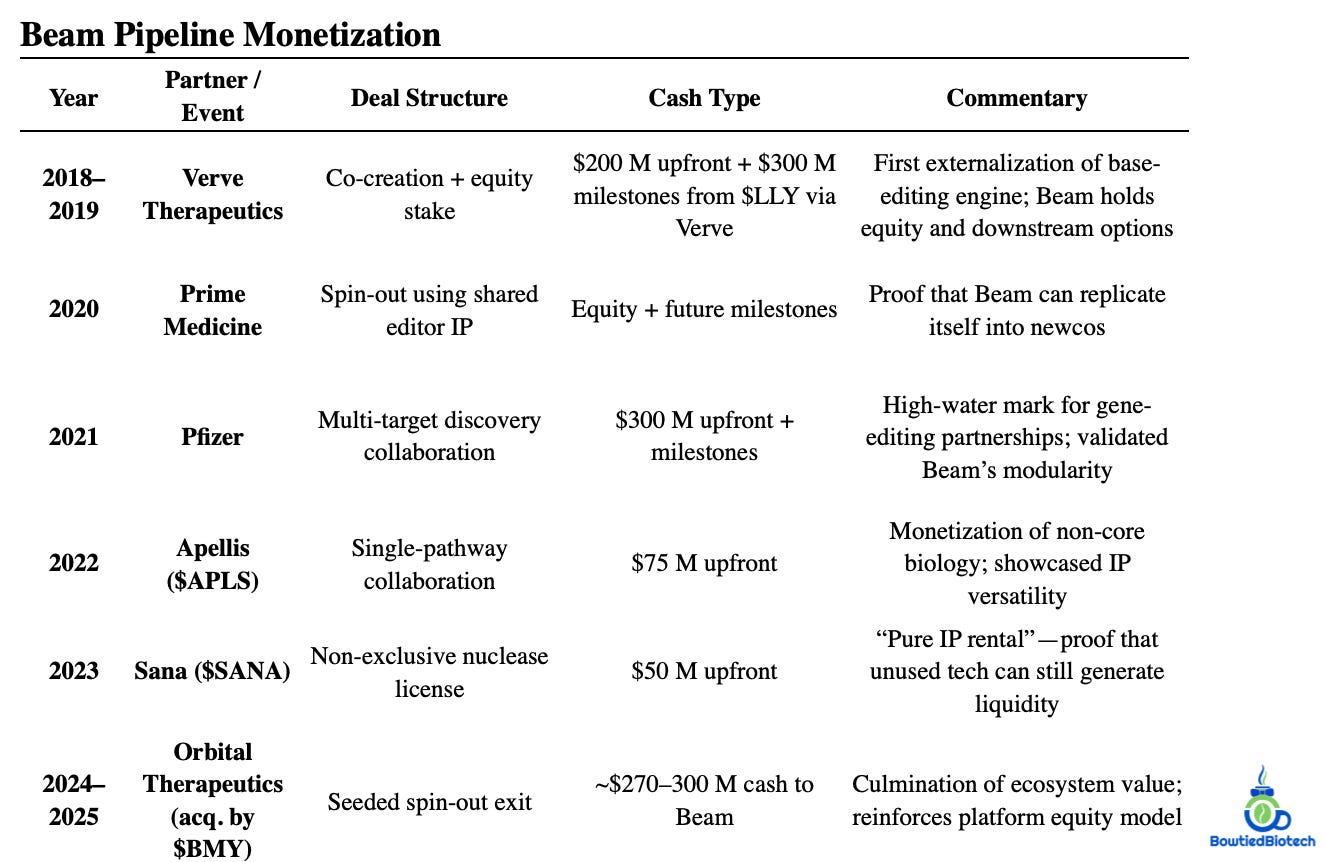
The most remarkable part is the diversity of deal structures. Beam monetized through equity seeding (Verve and Prime), non-exclusive licenses (Sana), and multi-target partnerships (Pfizer, Apellis).
These are examples of systematic releases of platform capacity.
Every deal validated a different axis of the platform (e.g., delivery, precision, durability, safety) while recycling capital into the next frontier.
This is not luck. It is platform design as a financing strategy. By creating modular assets that can be detached, licensed, or spun into newcos, Beam transformed each technological advancement into an external liquidity event.
Non-Dilutive Proceed Velocity
The phrase sounds like finance jargon, but it captures something powerful. Beam’s partnerships create velocity, cash inflows that move faster than burn. These are not passive royalties that take decades to accrue. They are upfront payments and equity gains that recycle within months or quarters, creating a self-funding rhythm.
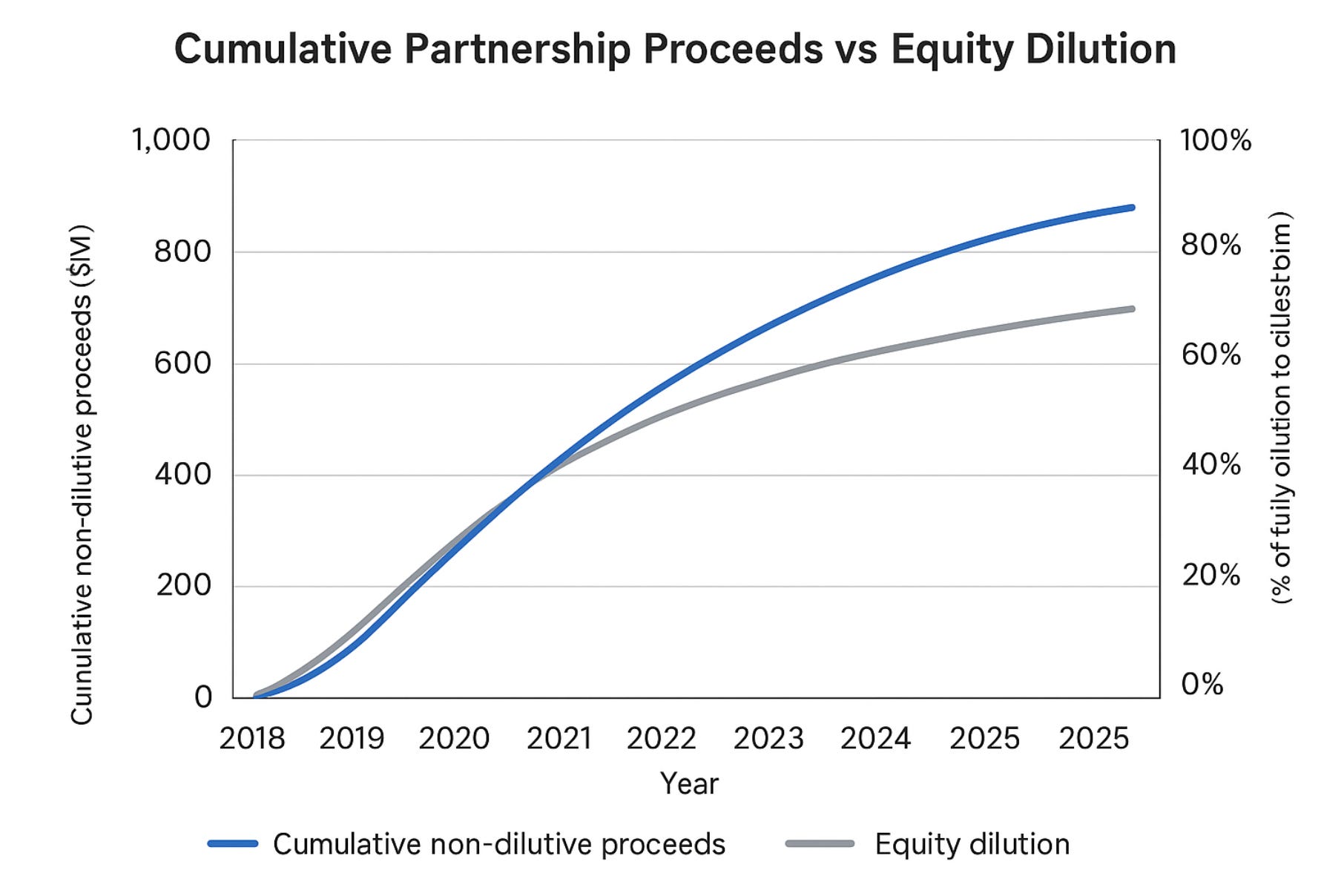
The figure below highlights how Beam’s monetization engine has effectively replaced traditional equity financing as its main source of growth capital.
Each major partnership (e.g., Pfizer, Apellis, Sana, and Orbital) generated proceeds large enough to offset roughly one to two years of operating burn, keeping the company’s balance sheet healthy through external cash rather than shareholder dilution.
After 2021, Beam’s cumulative equity issuance flattened while peers of similar stage continued raising heavily dilutive rounds. The widening gap between proceeds and dilution makes the “non-dilutive proceed velocity” curve tangible, showing that Beam’s platform design doesn’t just create optionality, it sustains itself.
Note: conceptual schematic based on publicly available deal terms and estimates.
Each transaction buys the company more time, which compounds value. Milestone payments act as synthetic cash equivalents that offset operating expenses. Beam essentially built a revolving door of external validation, internal reinvestment, and balance sheet extension. It has proven that innovation and capitalization can be aligned in a single engine.
This is how a platform company becomes immune to market cycles. When the crossover window closes, it still has deal velocity. When investor appetite fades, it has milestone triggers. The result is a biotech that behaves less like a speculative asset and more like a perpetual motion machine for translational capital.
Reading Between the Lines of Beam’s Strategy
Beam’s deals appear disconnected on the surface, but there is a deeper pattern. Each monetization occurred during a thematic peak. The Pfizer deal landed when mRNA liquidity was at its zenith. Apellis arrived during the complement therapy boom. Sana came during the iPSC wave. Beam used its modular tech to ride each macro trend, selling the right capability to the right buyer at the right moment.
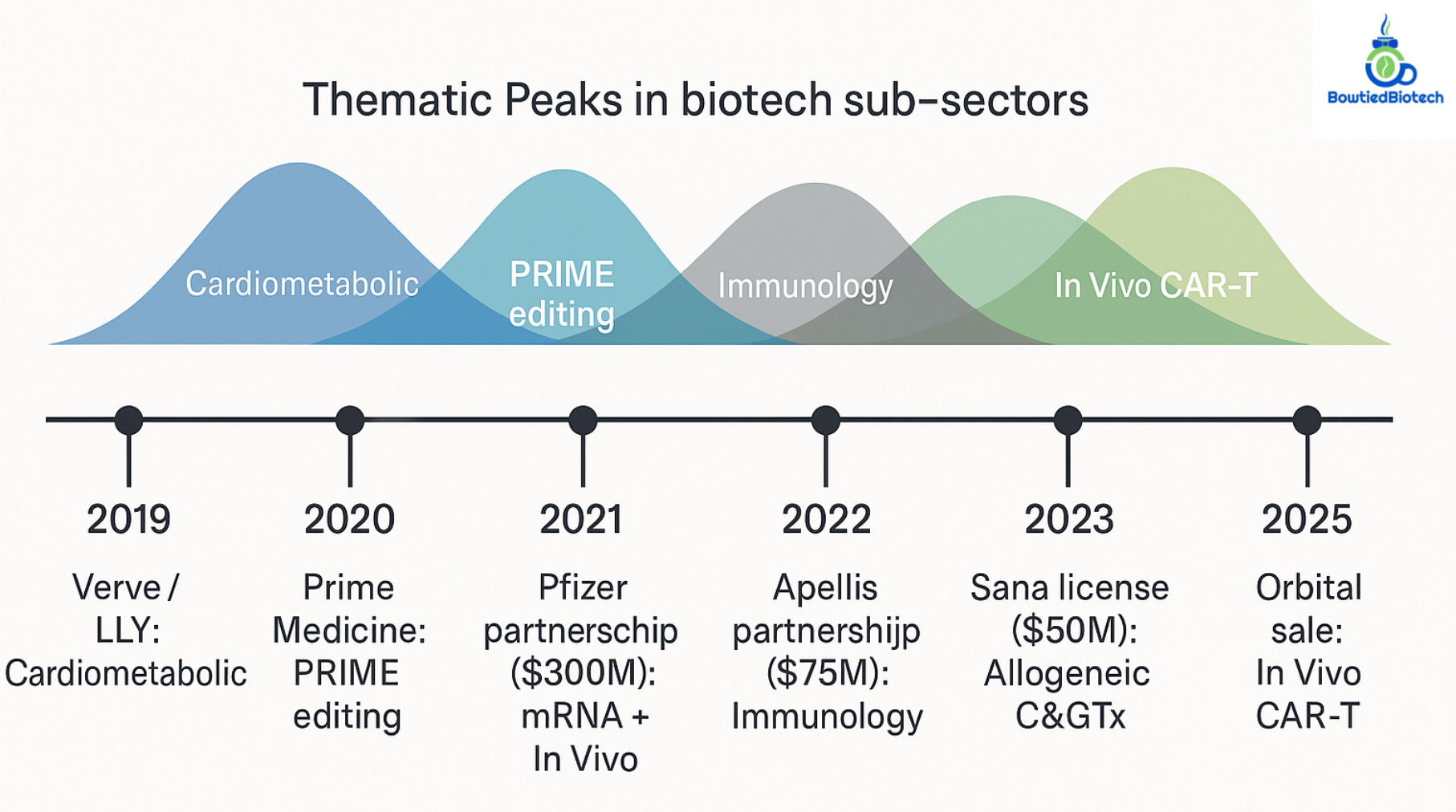
That timing mastery is rarely appreciated. Beam effectively turned market hype into non-dilutive capital. Each transaction also created second-order benefits. The partners generated validation data that reinforced Beam’s technology narrative, improving its future deal terms. The company monetized once through cash and again through credibility.
This dynamic shows how true platforms compound both liquidity and learning. Their value doesn’t come from a single success, but from a continuous feedback loop of experimentation, validation, and reinvestment.
The Difference Between Platform and Pipeline
Pipeline biotechs often call themselves “platform companies” because they share tools or pathways across a few programs. But the distinction is structural. A pipeline company’s cash flow depends on asset progression. A platform company’s cash flow depends on platform propagation.
A pipeline biotech might license an asset once every few years. A true platform can license a dozen capabilities in parallel. One produces value through linear development, the other through exponential reuse. Beam’s partnerships prove that recomposability (e.g., the ability to remix core technologies for new contexts) is the real moat.
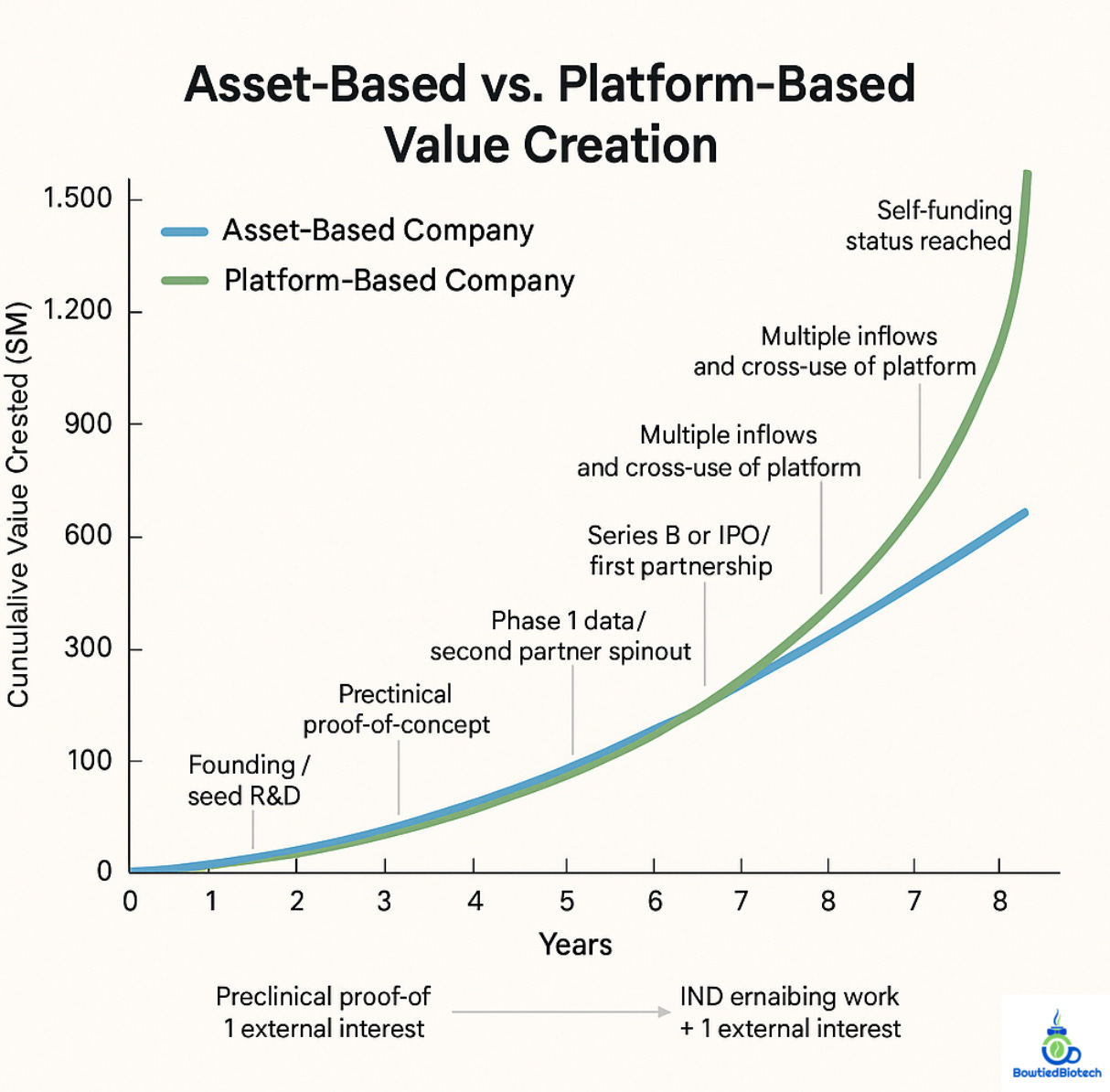
The difference isn’t cosmetic. It determines who survives a downcycle. Pipelines stall when lead programs delay. Platforms survive because they can sell new access rights faster than their cash runway shrinks.
Why Investors Should Care
For investors, Beam’s story reframes the idea of risk. Traditional biotech valuation is built on probability of success for lead assets. Platform valuation, however, is built on probability of adoption. The more partners integrate your tools, the more inevitable your economics become.
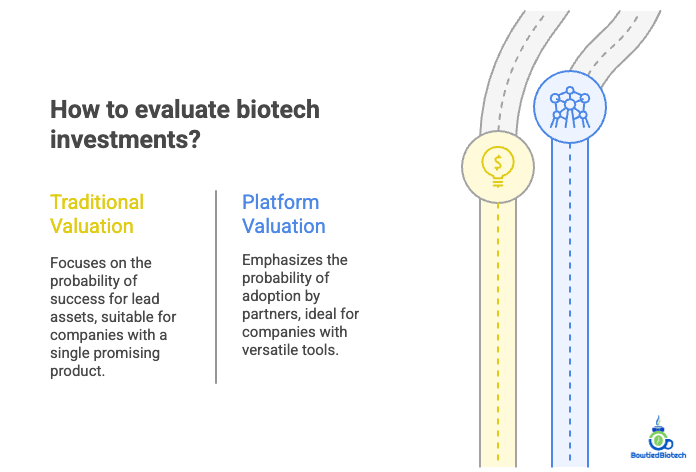
That creates a unique asymmetry. Even if none of Beam’s internal drugs reach market, the company still accrues value through ecosystem dependence. The platform becomes a toll road for genetic medicine. Each new user pays rent, and every success outside the company reinforces the moat inside it.
In this sense, Beam’s capitalization strategy resembles a venture portfolio. Each spin-out or partner is a derivative position. The company holds equity, milestones, or royalties across multiple independent experiments. It doesn’t bet on one program—it indexes the entire modality.
Lessons for Builders
Beam’s model can be distilled into five replicable principles.
(1) Engineer for reuse, not single wins. Design your tools so they can be repurposed with minimal rework.
(2) Build for liquidity events, not just clinical readouts. Each technical milestone should create optional monetization paths.
(3) Keep an IP choke point. Control the key component that others must license, whether it’s an editor, vector, or computational engine.
(4) Seed your own ecosystem. Retain equity in spin-outs to convert external validation into compounding exposure.
(5) Use timing as leverage. Partner when the world needs your tech, not when you need the cash.
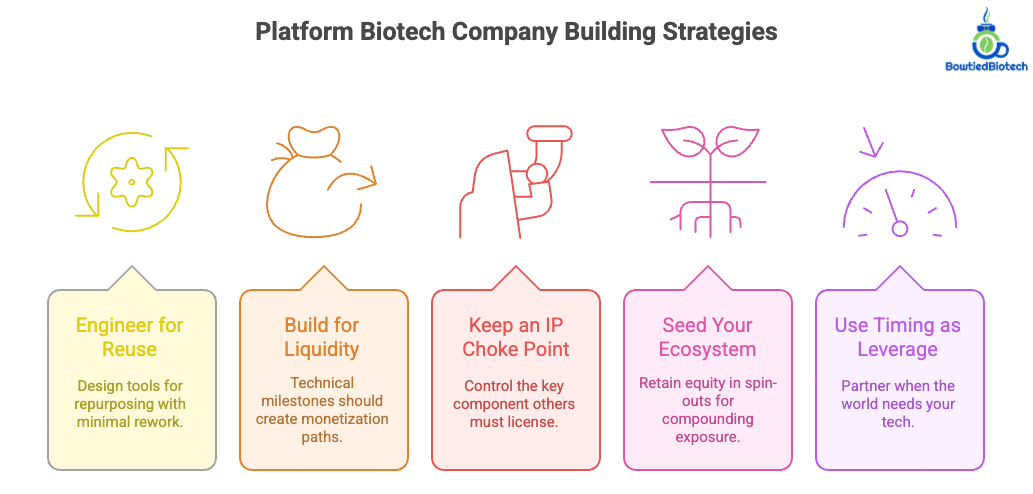
These are not abstract lessons. They form a playbook for founders designing new bioplatforms today. The goal is not to make one therapy work. It is to make many therapies possible.
The Next Generation of Platform Biotech
The next Beam will not emerge from the same terrain. The frontier has shifted. The most promising platform opportunities lie in programmable delivery, epigenetic editing, cell chassis engineering, and AI-linked wet-lab loops. These are the new toolkits with modularity baked in from day one.
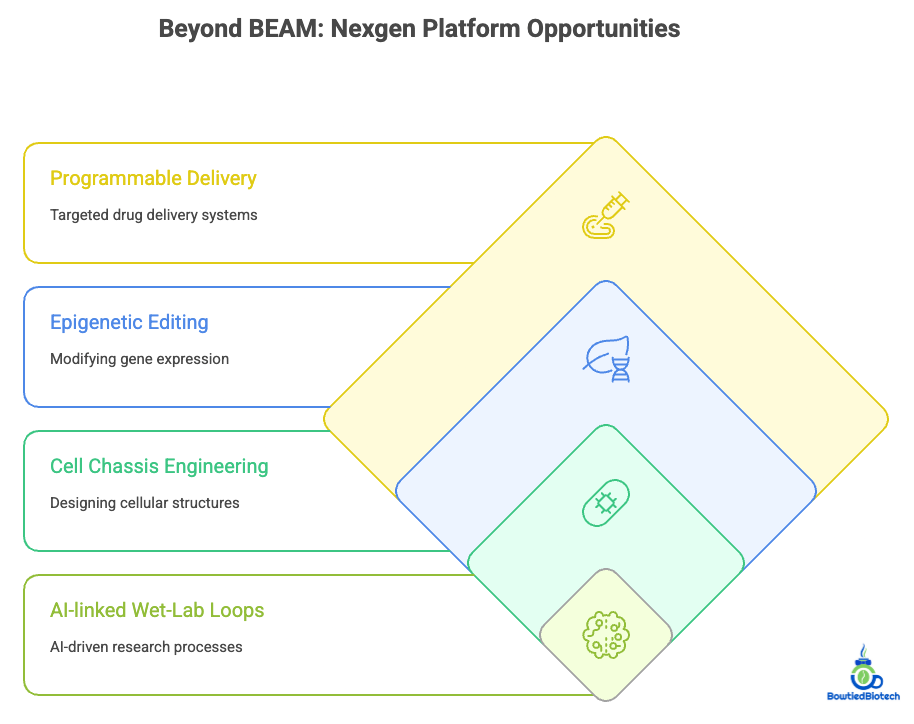
A delivery platform that can retarget the same LNP or capsid across tissues will command perpetual licensing revenue. A cell programming engine that standardizes immune or regenerative differentiation can spawn an entire family of newcos. A computational-experimental loop that continuously improves with data will monetize like SaaS. These are the new non-dilutive engines waiting to be built.
What connects them is not modality, but architecture. The next generation of platforms will be judged by recomposability, not discovery. Whoever builds systems that improve with each partnership, rather than degrade, will own the next decade of translational biology.
A Future of Self-Funding Innovation
The traditional biotech lifecycle assumes dilution as destiny. Raise, spend, hope, repeat. Beam proved that a different model is possible. Non-dilutive proceed velocity allows a company to compound both cash and capability simultaneously. That is not a financial gimmick—it is a new operating system for therapeutic innovation.
The implications are profound. A platform company that can generate predictable inflows through partnerships or spin-outs can self-finance development, attract better collaborators, and weather public market volatility. It becomes a perpetual engine of experimentation, not a hostage to capital markets.
Investors and founders who understand this will start building companies around velocity, not valuation. They will design their platforms as liquidity machines, not just research tools. And they will realize that the rarest commodity in biotech is not technology, but time—and the best companies are the ones that can buy more of it.
The Opportunity Ahead
The next platform wave will arise from founders who think like system architects rather than molecule hunters. They will focus on interfaces, data loops, and modularity. They will build delivery networks, epigenetic toolkits, and programmable biology factories that can monetize across dozens of verticals.
When investors look back at Beam, they will see more than a successful editor company. They will see the prototype of a new capital model. Beam proved that biological platforms can behave like software ecosystems—earning, learning, and compounding without dilution.
The next generation is forming now. Somewhere in a lab or incubator, a team is building the biological equivalent of AWS for therapeutic development. When that happens, investors will no longer ask whether a company can survive the next trial. They will ask how fast its platform can spin new worlds into existence.
CONCLUSION
Today the smartest founders aren’t building single drugs, they’re building systems that fund themselves. Beam proved that biology can be both innovative and cash-efficient when the platform becomes the product. The next generation of builders will take that lesson further (whether in delivery, epigenetic editing, or AI-driven experimentation) and create bioplatforms that compound capital and knowledge at once. The race is no longer to make one therapy work, but to design engines that never stop creating them.
As a reminder, if looking to go deeper into the topics we cover check out our website BowTiedBiotech.com, or DM us on twitter, or email us: bowtiedbiotech@gmail.com
DISCLAIMER
None of this is to be deemed legal or financial advice of any kind. All updates are sourced from publicly available disclosures. Insights are *opinions* written by an anonymous cartoon/scientist/investor.
TOP BOWTIEDBIOTECH NEWSLETTERS