

Hello Avatar! Welcome to another week of biotech analysis. Today’s commentary, as always on Thursday, focuses on the general market update. This week confirmed the playbook. Biotech can rally and capital can return quickly, but funding is flowing to companies with clean catalysts and tight execution. Secondaries continue to dominate the financing landscape, while IPO activity remains scarce. Investors are rewarding near-term proof and punishing duration risk. In this environment, cost of capital shapes trial design, and clock discipline matters as much as mechanism.
We are now publishing 7x per week according to the following cadence:
Mondays: Stocks
Tuesdays: Biotech
Wednesdays: Podcast
Thursdays: Markets
Fridays: News
Saturdays: Podcast
Sundays: Strategy
We are also publishing unique content on X - be sure to follow up if you are not already @BowTiedBiotech. And to check-out the archive of our work on X you can find it on our website at: BowtiedBiotech.subtack.com/x-articles.
SUBSCRIBE TO PODCAST HERE:
Please help spread the work by subscribing and hitting the share button if you are enjoying content!
Lots to cover this week, let's get started!

Macro Update
The Federal Reserve held its benchmark interest rate at 3.75%-4.00% on Wednesday, October 28, as persistent inflation and resilient economic growth complicated the path forward for monetary policy. The decision followed September’s quarter-point increase, with two policymakers dissenting in favor of another hike. Meanwhile, the 10-year Treasury yield climbed to approximately 5.05%, reinforcing expectations that borrowing costs could remain elevated well into 2027. Despite the restrictive environment, broader equities have remained resilient, with the S&P 500 and Nasdaq each gaining 0.3% following the announcement. The disconnect between strong equity markets and elevated bond yields raises an important question about how much longer investors will tolerate expensive valuations and uncertain future returns.
For biotechnology, the implications are particularly significant. Unlike profitable businesses generating predictable cash flows, most development-stage biotech companies depend on capital markets to finance years of clinical trials before generating meaningful revenue. Higher interest rates create pressure from two directions. First, elevated discount rates reduce the present value of future commercial revenues, disproportionately affecting companies whose potential earnings remain five or ten years away. Second, investors can now earn approximately 5% on longer-term government bonds without assuming the clinical, regulatory, and financing risks associated with speculative biotech equities. This increases the return investors may demand to justify holding early-stage biotechnology companies, potentially compressing valuations even when the underlying clinical thesis remains unchanged.

However, the sector’s recent performance suggests the relationship between interest rates and biotech valuations is not entirely straightforward. The SPDR S&P Biotech ETF (XBI) was up approximately 27% year-to-date through October 27, substantially outperforming the broader market despite elevated Treasury yields. This resilience suggests that company-specific catalysts, improving investor sentiment, and expectations for future commercial opportunities can outweigh macroeconomic headwinds. The distinction becomes particularly important when evaluating balance sheets. Companies with sufficient cash to reach major clinical readouts or regulatory decisions have greater flexibility, while those approaching financing requirements may face substantial dilution if capital remains expensive. A successful trial can still create significant shareholder value, but the financing required to reach that milestone increasingly matters.
Looking ahead, the key variable for biotech may be less about when the Federal Reserve begins cutting rates and more about whether capital markets remain receptive to funding clinical development at reasonable valuations. With inflation still above the Fed’s 2% target and additional tightening remaining a possibility, investors should not assume that cheaper capital is imminent. For development-stage biotech, this environment reinforces the importance of cash runway, capital efficiency, and catalyst timing. Companies capable of producing meaningful clinical data without returning to the equity markets may command a premium, while those dependent on repeated financings could struggle even with promising science. Ultimately, higher interest rates do not eliminate the opportunity in biotech, but they make the cost of reaching a successful outcome considerably more important.
Introduction
This week, we’re looking at a regulatory development that could fundamentally change how personalized genetic medicines move from the laboratory to patients. The FDA’s newly proposed framework for individualized genome editing introduces the possibility of developing multiple patient-specific therapies under a single regulatory approval, potentially removing one of the biggest economic barriers facing ultra-rare disease treatments. What makes this particularly interesting is how far the implications extend beyond CRISPR itself. From reusable clinical evidence and modular manufacturing to the emergence of therapeutic platforms capable of addressing entire families of mutations, the opportunity raises important questions about how the next generation of biotech companies will be built and valued. We’ll examine the science behind the proposal, where the regulatory flexibility ends, and why some of the biggest beneficiaries may be companies investors aren’t currently watching.
A Regulatory Change With Much Larger Consequences
For decades, biotechnology has operated under a fairly rigid development model. A company identifies a therapeutic candidate, generates preclinical evidence, conducts clinical trials, and submits an application seeking approval to market that product. Each new candidate generally carries its own development costs, regulatory uncertainty, and financing requirements. The model works reasonably well when a drug can reach thousands of patients. It becomes considerably harder to justify when the entire addressable population consists of twenty patients, five patients, or a single child with a pathogenic mutation that no one else carries.
On October 27, 2026, the FDA released draft guidance titled Individualized Human Genome Editing Products, Considerations for BLA Submission and Postapproval Management. The document proposes a framework under which multiple individualized genome editing variants can potentially operate within a single Biologics License Application. The key concept is an Individualized Feature Space, or IFS, that defines the permissible variation among related genome editing products. Under the proposed approach, sponsors could add qualifying variants after initial licensure without conducting a separate clinical development program for every mutation. The FDA still expects evidence supporting safety, potency, and manufacturing consistency. But the possibility of extending one regulatory approval across multiple related treatments represents a substantial departure from how investors traditionally think about drug development.
The implications reach beyond the regulatory process. If developers can establish a scientifically defensible relationship between a validated editing platform and subsequent patient-specific variants, the economics of genetic medicine begin to change. Development costs become more reusable. Clinical evidence accumulates across related products. Manufacturing infrastructure becomes an asset that supports multiple therapeutic applications rather than a cost allocated to one commercial candidate. The most interesting possibility is that companies will eventually organize their pipelines around groups of genetically related patients rather than individual drug products. That future remains unproven, but the FDA has now outlined a regulatory structure capable of supporting it.
The Patient Who Exposed the Problem
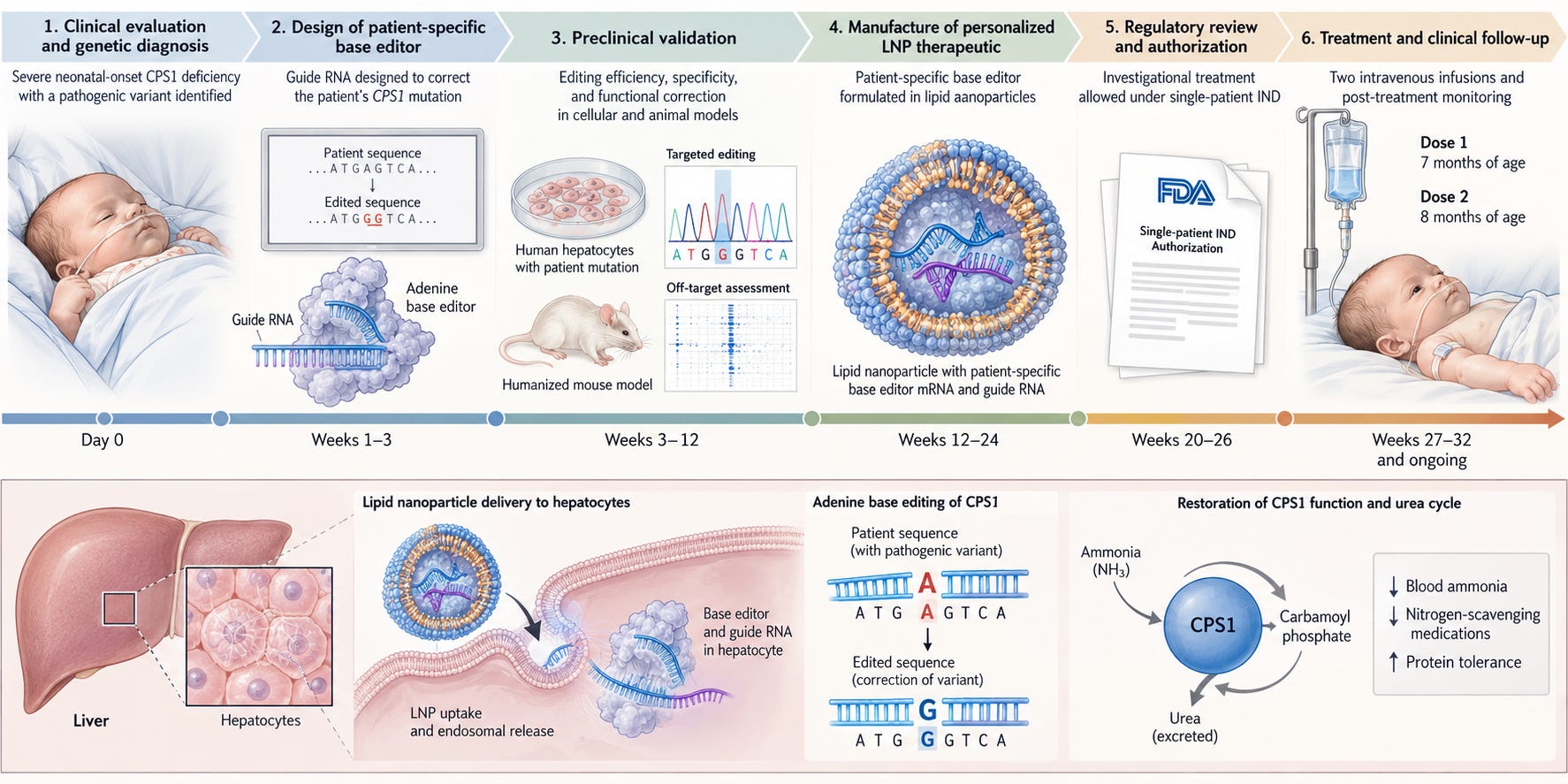
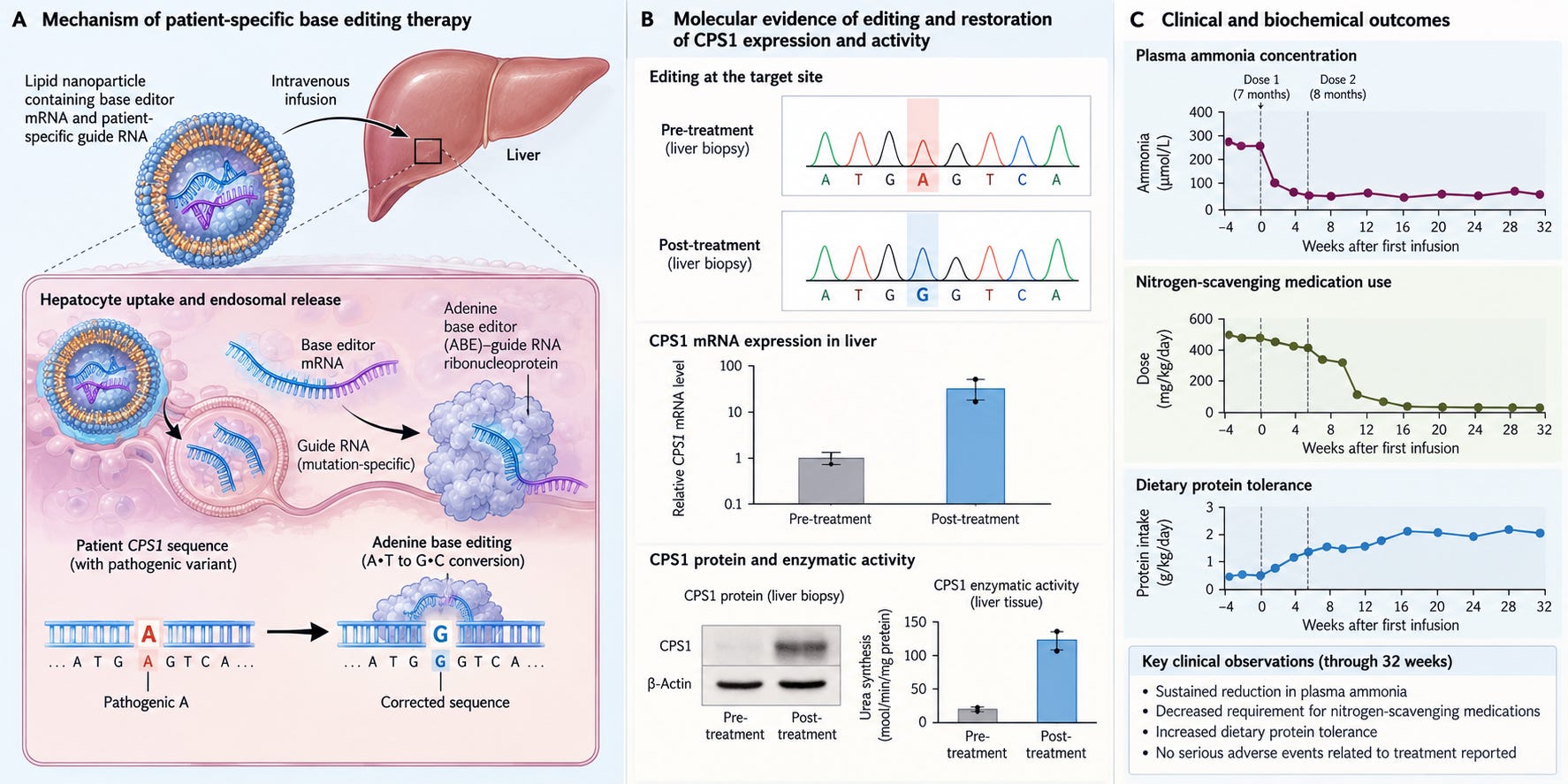
In 2025, researchers at Children’s Hospital of Philadelphia and the University of Pennsylvania reported treating an infant with severe carbamoyl phosphate synthetase 1 deficiency using a customized in vivo base editing therapy. CPS1 deficiency is a rare metabolic disorder that disrupts the urea cycle, preventing the body from adequately converting ammonia into a form that can be safely eliminated. Severe neonatal disease can produce life-threatening hyperammonemia and neurological injury. The investigators developed a lipid nanoparticle formulation carrying the editing machinery needed to address the child’s specific genetic defect. From diagnosis to treatment, the effort took approximately six months.
The initial report described two infusions at approximately seven and eight months of age. During the seven weeks following the first treatment, the child tolerated increased dietary protein and required a lower dose of nitrogen-scavenging medication. Investigators reported no serious adverse events during that initial observation period. These findings were encouraging, particularly given the severity of the underlying disease, but the study involved one patient and limited follow-up. Improvements in metabolic management do not establish permanent correction of the disease, and the relationship between editing efficiency and long-term clinical benefit remains uncertain. The result demonstrated feasibility under extraordinary circumstances, not a broadly validated commercial development process.
What makes this case important is the amount of infrastructure required to treat one patient. The researchers had to identify an appropriate editing strategy, characterize its activity, assess potential unintended edits, manufacture clinical material, and obtain regulatory authorization within a compressed timeline. Much of that work involved capabilities that should theoretically transfer to another patient with a different mutation. Yet conventional product development provides limited opportunity to distribute those costs across many unrelated individualized treatments. The case exposed an economic problem that genome editing technology alone cannot solve. The FDA’s new framework appears designed to address precisely that gap.
What the FDA Actually Changed
The October guidance introduces a regulatory approach for individualized human genome editing products containing multiple related variants. Rather than requiring every sequence variation to become an entirely separate licensed product, the FDA proposes that sponsors describe an acceptable range of variation within a single application. This Individualized Feature Space establishes boundaries around the genome editing components and the characteristics that define the product family. The central scientific question is whether evidence generated from representative variants can adequately support the safety and effectiveness of additional variants that remain within those boundaries.
That distinction matters. The FDA is not proposing that every CRISPR treatment become interchangeable with every other CRISPR treatment. A guide RNA targeting one pathogenic sequence can behave differently from another guide RNA, even when both use the same editing enzyme and delivery system. Different sequences introduce different off-target possibilities, editing efficiencies, and biological consequences. The proposed framework requires sponsors to characterize those differences and demonstrate that the resulting products remain sufficiently consistent with the approved platform. The boundaries of the IFS therefore determine how broadly the approval can extend.
The guidance is also still a draft. It does not establish a legally binding entitlement to add variants, guarantee that a sponsor can avoid new clinical studies, or eliminate the FDA’s authority to request additional evidence. Nevertheless, the agency has acknowledged that individualized genome editing products need a regulatory model that accommodates controlled variation. That acknowledgment is significant because it changes the development question. Instead of asking regulators to evaluate each mutation-specific product in isolation, sponsors can begin designing programs around the scientific evidence required to support an entire family of treatments.
The Individualized Feature Space Becomes the Product
The most important commercial implication may be hidden in the definition of the Individualized Feature Space itself. A conventional biotechnology company often measures pipeline value through the number of candidates it controls and the commercial opportunity attached to each candidate. Under an IFS-based development model, a company could potentially control a validated therapeutic framework capable of generating many patient-specific variants. The framework would have value because each additional treatment draws upon established regulatory evidence and shared manufacturing capabilities.
Consider a hypothetical platform designed to correct multiple pathogenic variants in one disease-associated gene. The editing enzyme, delivery vehicle, manufacturing process, and much of the analytical testing remain consistent, while the guide RNA changes to address specific mutations. The sponsor develops representative variants, establishes their activity and safety, and seeks approval for a defined range of permitted variation. If the FDA accepts that approach, the company can potentially introduce additional variants within the approved boundaries using targeted analytical evidence rather than repeating the entire clinical program. This is the type of architecture the guidance is intended to accommodate, although the acceptable degree of variation will depend on the underlying biology and supporting data.
The interesting question is how broadly sponsors can define those boundaries without weakening the scientific argument. A narrow IFS may be relatively straightforward to validate but cover only a handful of mutations. A broad IFS offers greater commercial reach but introduces additional uncertainty around off-target activity and biological equivalence. Companies will need to optimize this trade-off from the beginning. The size and quality of the validated feature space could eventually become a more meaningful measure of platform value than the number of nominal drug candidates listed in a corporate presentation.
The First Approval Becomes a Capital Investment
A conventional clinical development program often treats regulatory approval as the endpoint of a single asset’s development. Under the proposed framework, the first approval can serve another function. It establishes the evidence base and operating infrastructure for subsequent variants. This changes how companies should think about the cost of the initial development program. Some expenses that appear excessive when allocated to one rare disease treatment become more reasonable if they support dozens of related treatments over time.
Imagine a hypothetical company spending $120 million to establish a genome editing platform and obtain its initial approval. Under a conventional model, that investment must be justified primarily by the commercial prospects of the approved product. If the validated framework subsequently supports twenty additional variants, however, the company can spread portions of its original platform investment across a larger treated population. The economics improve only if the additional variants require substantially less development work and can be manufactured reliably. The $120 million figure is illustrative, not a forecast of what the FDA framework will cost to implement.
This creates an important distinction between companies that develop an individual treatment and companies that develop reusable therapeutic infrastructure. Investors should examine how much of the initial investment remains applicable when the target sequence changes. A platform that requires extensive new toxicology studies, manufacturing validation, or clinical testing for every variant offers limited economic advantage. A platform that can reuse most of its established evidence may become considerably more valuable with each successful application.
A Different Way to Select Diseases
Most genetic medicine companies prioritize diseases based on patient population, biological tractability, competitive positioning, and the probability of achieving regulatory approval. Those considerations remain important, but an IFS-based development model introduces another variable. The number of pathogenic mutations that can be addressed within one validated therapeutic framework may influence which diseases offer the most attractive development opportunities.
A disorder caused by numerous pathogenic variants in the same gene could become more attractive if the mutations can be addressed using related editing strategies. The sponsor would still need to account for differences in mutation biology. A loss-of-function mutation that reduces protein production is not necessarily equivalent to a gain-of-function mutation that produces a toxic protein. Some variants may require precise correction, while others can be addressed through gene disruption or alternative editing strategies. These distinctions can limit how broadly one platform applies, even when all the patients share the same disease diagnosis.
The opportunity becomes more interesting when developers group patients by therapeutic mechanism rather than diagnosis alone. Several mutations within one gene may support a common intervention. Conversely, two mutations associated with the same clinical disorder may require fundamentally different approaches. Future pipeline construction could therefore begin with a map of pathogenic variants, their molecular consequences, and their compatibility with specific editing technologies. The companies that perform this analysis early may identify economically viable treatment clusters that conventional market sizing overlooks.
The Mutation Atlas Could Become a Strategic Asset
If regulatory approval increasingly accommodates related variants, the quality of a company’s mutation-level information becomes more important. Developers will need to understand which pathogenic variants exist, how frequently they occur, and whether their molecular consequences can be addressed using a common editing architecture. Public genetic databases provide a starting point, but clinical interpretation remains difficult. Variant classifications change, disease severity varies, and many reported variants lack sufficient functional evidence.
This creates an opportunity for companies that connect genomic information with functional testing. Rather than selecting one lead mutation and postponing the rest, a developer could construct a systematic library of clinically relevant variants and test their compatibility with a proposed editing platform. The results would help define the boundaries of the IFS and identify variants that require additional engineering. Such a library would also expose which patients remain outside the platform’s current capabilities. That information has commercial value because it helps the company estimate the actual treatable population rather than relying on broad disease prevalence figures.
There is a less obvious competitive implication. A company that controls a validated collection of mutation-specific assays, clinical relationships, and manufacturing specifications may become difficult to replicate even when competitors have access to similar editing enzymes. The value would come from accumulated evidence and operational experience. Patents remain important, but the practical ability to translate a patient’s genotype into a tested therapeutic variant may become a more durable advantage than ownership of any one guide RNA.
The Bottleneck Moves Into Translational Biology
The proposed regulatory flexibility does not remove the need to establish that an edit produces the intended biological effect. This is where the framework becomes scientifically demanding. Correcting a DNA sequence is an intermediate result. The therapeutic objective is to restore sufficient cellular function to improve the patient’s disease. The relationship between those outcomes varies substantially across genetic disorders.
For some metabolic diseases, restoring a relatively small amount of enzyme activity may provide meaningful benefit. Other conditions require correction in a much larger proportion of affected cells. The relevant threshold depends on tissue distribution, protein function, and disease progression. A therapy that achieves impressive editing efficiency in cultured cells may produce limited clinical benefit if the delivery system reaches only a small fraction of the necessary tissue. Likewise, an edit that appears successful at the DNA level may fail to restore normal RNA processing or protein function.
The translational opportunity lies in developing reliable relationships between molecular correction and clinically meaningful function. Companies should invest in assays that quantify the downstream consequences of editing rather than relying exclusively on editing percentages. For an enzyme deficiency, that could involve functional enzyme activity and disease-specific metabolic biomarkers. For a hematologic disorder, the relevant measurements may involve corrected cell populations and the functional properties of their descendants. These relationships will determine whether evidence from one variant can reasonably support another. The better a company understands them, the stronger its argument for extending an approved platform.
The Hidden Importance of Potency Assays
Potency testing rarely receives the same attention as clinical efficacy data, but it may become one of the most important determinants of whether individualized genome editing can scale. A manufacturer needs to demonstrate that each therapeutic variant has the biological activity required for its intended purpose. When the target sequence changes, the company must determine whether its existing potency assays remain informative or whether the new variant introduces a functional difference that requires additional testing.
A simple editing percentage is not always sufficient. Two variants may produce similar rates of genomic modification while generating different functional outcomes. One edit may restore normal protein expression, while another produces an altered transcript with limited biological activity. Off-target effects and unintended on-target changes can also differ between variants. Sponsors therefore need analytical methods that connect editing activity to the biological mechanism of the disease. The FDA’s framework increases the importance of developing these methods early because their usefulness across variants influences the scope of the platform.
This creates a potential opportunity for specialized assay developers and contract laboratories. If individualized therapies become more common, companies will need validated functional testing systems that can accommodate different mutations without requiring complete redevelopment for every patient. The market may reward technologies that reduce the time between identifying a pathogenic variant and demonstrating that a proposed edit has the intended biological effect. These tools are unlikely to receive the attention given to editing enzymes, but they could become essential components of the therapeutic development process.
Off-Target Risk Refuses to Disappear
The strongest argument against treating related genome editing variants as members of one product family is that small sequence changes can produce meaningful differences in biological risk. Guide RNA sequences determine where editing machinery binds, and changes in those sequences can alter potential off-target interactions. A platform may have an established delivery system and editing enzyme, yet still produce a variant with a substantially different safety profile.
The FDA’s April 2026 draft guidance on next-generation sequencing methods for genome editing safety assessment reflects the importance of systematically identifying unintended editing events. The October framework should be understood alongside that earlier document. Sponsors seeking to add variants will need scientifically appropriate methods for assessing sequence-specific risks. Shared platform evidence can inform the evaluation, but it cannot establish that every new guide RNA is safe simply because an earlier guide RNA performed well. Different genomic targets also create different risks from large deletions, rearrangements, or unintended modifications near the intended editing site.
This may create an unexpected constraint on platform expansion. A company could develop a highly efficient editing system but discover that its ability to add new variants is limited by the complexity of characterizing off-target effects. In that scenario, improvements in predictive modeling and sequencing-based safety analysis become commercially important. Investors should pay close attention to whether developers can demonstrate reproducible relationships between computational predictions, experimental off-target measurements, and observed biological outcomes. A weak relationship would undermine the case for extrapolating safety across variants.
Manufacturing Becomes a Competitive Advantage
Individualized genome editing introduces a manufacturing problem that differs from conventional pharmaceutical production. Instead of producing large batches of an identical product for thousands of patients, developers may need to manufacture smaller quantities of multiple closely related variants. Each variant must satisfy applicable quality standards, and manufacturers must ensure that the correct product reaches the correct patient. This increases the importance of identity testing, batch documentation, and process controls.
The October FDA guidance specifically addresses manufacturing process validation and the identification of individualized products. For in vivo therapies, identity testing can involve confirming the variable editing component, such as the guide RNA sequence. For ex vivo therapies, the manufacturer must verify the intended genomic edit in the cellular product and maintain the chain of identity linking the patient’s starting material to the final treatment. These requirements make sense clinically. Administering the wrong variant would represent a potentially serious manufacturing failure, even if the product otherwise met conventional purity specifications.
The commercial opportunity is in reducing the cost and complexity of controlled variation. A manufacturer that can change a guide RNA sequence while maintaining a validated process may eventually achieve a lower marginal cost per variant than one that treats every change as a new manufacturing program. This favors modular production systems, standardized analytical methods, and strong digital traceability. The companies that master these capabilities may become attractive partners for therapeutic developers that possess strong biological expertise but lack the infrastructure to manufacture individualized products efficiently.
The Rise of Therapeutic Foundries
A plausible long-term outcome is the emergence of specialized manufacturing organizations that operate more like therapeutic foundries than conventional drug manufacturers. A developer identifies the pathogenic mutation and selects an appropriate editing strategy. The foundry produces the corresponding therapeutic variant using a validated manufacturing architecture, performs the necessary analytical testing, and releases the product under established quality procedures. The concept resembles modular manufacturing, but with unusually demanding biological and regulatory requirements.
Such an organization would need more than manufacturing capacity. It would require expertise in sequence design, analytical validation, and product identity management. It would also need clear responsibility for regulatory compliance and post-treatment safety monitoring. The model becomes more attractive if multiple therapeutic developers use related editing systems or compatible delivery technologies. Standardization would allow the foundry to distribute fixed infrastructure costs across a larger number of programs.
The limitation is that genome editing platforms are not automatically compatible. Different enzymes, delivery vehicles, tissues, and editing mechanisms may require distinct manufacturing processes. A foundry attempting to support too many unrelated technologies could lose the standardization advantage that makes the model attractive. The most viable early businesses may specialize in a narrow set of editing modalities and tissue applications. Broad platform expansion would follow only after the underlying processes demonstrate reproducibility.
The Economics of One Patient Begin to Change
Personalized genome editing has historically faced a difficult commercial equation. The scientific work required to develop a treatment can resemble a conventional drug development program, while the potential revenue may come from only one or a handful of patients. Philanthropic funding and academic research can support individual cases, but these approaches are difficult to scale into a sustainable commercial industry. Regulatory flexibility addresses part of this problem by allowing certain development costs to be reused.
Consider a simplified hypothetical example. A developer spends $100 million establishing a platform and obtaining initial approval. Each subsequent variant requires $1 million in incremental development and manufacturing expense. If the platform ultimately treats one hundred additional patients, the initial investment represents approximately $1 million per additional patient before accounting for the first treated population, financing costs, and ongoing operations. Adding the hypothetical incremental expense produces approximately $2 million per patient before commercial overhead and other costs. These numbers are illustrative and should not be interpreted as estimates of actual manufacturing or development costs.
The example shows why the number of eligible patients matters, even under a more flexible approval framework. A platform treating five patients may remain economically unattractive. A platform treating several hundred patients across related mutations offers a different financial proposition. But regulatory efficiency does not guarantee commercial viability. Companies must still identify patients, manufacture treatments, secure reimbursement, and maintain long-term safety monitoring. The new framework can reduce duplicated development work. It cannot eliminate the economic consequences of extremely small patient populations.
A New Way to Value Genome Editing Companies
Investors currently evaluate genome editing companies using a combination of pipeline progress, addressable market size, clinical probability of success, and financing requirements. The proposed FDA framework suggests that platform reuse should receive greater attention. A company with one validated editing system capable of supporting numerous related variants may have more commercial optionality than a company developing several unrelated programs that each require substantial independent investment.
The key is to distinguish genuine platform reuse from a marketing claim. Many biotechnology companies describe their technology as a platform because it can theoretically address multiple targets. That does not establish that the FDA will accept shared evidence across those targets. Investors should examine the specific components that remain unchanged between variants and the experimental work required when a new variant is introduced. The more the company must repeat, the less valuable the regulatory flexibility becomes.
A useful valuation framework would separate the economics of the initial approved product from the expected value of future variants. The latter depends on the number of eligible mutations, the probability that each variant falls within the accepted IFS, the incremental cost of development, and the time required to make treatment available. Investors should discount those opportunities according to their actual scientific and regulatory uncertainty. Counting every theoretically addressable mutation as a future commercial product would produce inflated valuations and ignore the biological limitations of the framework.
The Clinical Trial Model Could Evolve
Traditional clinical trials assume that investigators can administer the same therapeutic product to a defined patient population and compare outcomes under a common protocol. Individualized genome editing complicates that structure because patients may receive variants designed for their specific mutations. The FDA’s February 2026 plausible mechanism guidance and its October IFS proposal collectively suggest a path toward evaluating related therapies using shared scientific evidence and appropriately designed clinical programs.
One possibility is the broader use of master protocols that evaluate multiple related variants within a common disease framework. Investigators could assess whether different treatments produce consistent biological effects while collecting safety data across the platform. The statistical challenges are substantial. Patients may have different baseline disease severity, mutation-specific biology, and clinical trajectories. Small sample sizes make it difficult to separate treatment effects from natural disease variation. A shared protocol improves consistency but does not automatically resolve those problems.
The most useful clinical programs will probably combine strong natural history data with objective functional biomarkers and carefully selected clinical outcomes. Developers should establish these resources before they begin treating patients. If a company waits until after its first successful treatment to assemble the relevant natural history cohort, it may discover that the evidence needed to support broader approval is incomplete. Clinical trial infrastructure could therefore become a strategic asset that companies build alongside the editing platform rather than after it.
The Biological Limits of Extrapolation
There is a temptation to assume that successful editing of one mutation provides strong evidence that another mutation in the same gene will respond similarly. Sometimes that assumption will be reasonable. Other times it will be wrong. A gene can contain mutations that alter protein expression, protein stability, catalytic activity, or cellular localization. Correcting those mutations may require different editing strategies and produce different biological consequences.
This distinction becomes especially important when comparing loss-of-function and gain-of-function disorders. Restoring a deficient protein may require precise correction or increased functional expression. Disrupting a toxic protein may instead require reducing or eliminating its production. Both approaches involve genome editing, but their therapeutic mechanisms differ substantially. Even within one disease, variants that appear genetically related may fall outside a common scientific framework if their functional effects differ.
The strongest platforms will therefore define their scope around biological equivalence rather than simply shared genetic location. Investors should be skeptical of companies that use the number of known pathogenic variants as a direct proxy for the number of treatable patients. The relevant question is how many variants can be addressed with a sufficiently consistent therapeutic mechanism and acceptable safety profile. That number may be much smaller than the total number of mutations associated with a disease.
Why Delivery Technology Could Capture More Value
Genome editing receives enormous attention because the editing machinery determines what genetic change is possible. But therapeutic translation depends equally on delivering that machinery to the appropriate cells. A highly precise editor has limited clinical value if it cannot reach the relevant tissue at sufficient concentrations. Delivery systems also influence toxicity, dosing flexibility, and the feasibility of treating patients with different disease characteristics.
The CPS1 case illustrates the importance of this relationship. Investigators used lipid nanoparticles to deliver a customized base editing system to the liver, an organ already accessible to several established nucleic acid delivery technologies. That delivery advantage contributed to the feasibility of the treatment. Many other genetic disorders affect tissues that remain substantially harder to reach, including the central nervous system and skeletal muscle. The FDA’s proposed framework does not solve these delivery limitations.
This creates a potentially important investment distinction. Companies developing reliable delivery systems for difficult tissues may benefit from a larger number of individualized editing programs, even if they do not control every mutation-specific therapeutic design. A delivery technology that supports multiple compatible editing variants can become a recurring component of the development process. The opportunity is especially interesting where delivery performance remains the primary barrier to translating an otherwise credible editing strategy into a clinical treatment.
Reimbursement Is the Missing Half of the Equation
The FDA can create a regulatory pathway for individualized genome editing, but commercial adoption depends on whether healthcare systems can pay for the resulting treatments. Ultra-rare diseases present difficult reimbursement questions because the costs of development and manufacturing must be recovered from very small populations. Even if a company reduces the incremental cost of producing a new variant, the final treatment may remain expensive.
Payers will want evidence that a therapy produces durable clinical benefit. This is particularly challenging when treatment involves one-time genome editing and long-term outcomes remain uncertain. A patient may show improvement in a biomarker without demonstrating that the treatment prevents hospitalization, organ damage, or other costly complications. Outcomes-based reimbursement arrangements offer one possible approach, but they introduce their own challenges around follow-up duration and the measurement of treatment success.
The emerging regulatory framework may eventually encourage closer coordination between developers, specialized treatment centers, and payers. A company that establishes standardized outcome measurements across related variants could generate evidence that supports both regulatory decisions and reimbursement negotiations. This is another reason why clinical data infrastructure matters. The ability to document durable benefit across a family of individualized therapies may become as important commercially as the ability to manufacture those therapies.
The Companies That Benefit May Not Be the Obvious Ones
When investors hear about regulatory flexibility for genome editing, the natural response is to look at publicly traded companies developing CRISPR-based therapeutics. Some will benefit, particularly those with modular editing systems and strong delivery capabilities. But the FDA’s framework also creates opportunities for companies that provide the infrastructure required to develop and manufacture individualized variants.
Analytical testing providers, specialized manufacturers, sequencing companies, and developers of functional disease models all have potential exposure to this emerging market. Their opportunity depends on whether individualized genome editing becomes sufficiently common to support recurring commercial demand. Unlike a therapeutic developer, an infrastructure provider may generate revenue from multiple programs without bearing the full clinical risk of any one product. That diversification could prove attractive if the field expands but individual programs continue to experience substantial attrition.
The risk is that the market remains too small to justify specialized infrastructure. A handful of academic treatments will not sustain an extensive commercial ecosystem. Investors should therefore watch for evidence of repeatability rather than isolated clinical successes. Multiple patients treated through a shared development process, falling manufacturing costs, and successful regulatory additions of new variants would provide stronger evidence of a scalable industry than another single-patient proof of concept.
The Regulatory Precedent Could Extend Beyond Genome Editing
The October guidance focuses on individualized human genome editing products, but the underlying regulatory question has broader relevance. How should regulators evaluate therapies that share a common technological architecture while differing in a patient-specific component? That question also arises in antisense oligonucleotide development and other sequence-directed therapeutic approaches.
The FDA’s February 2026 plausible mechanism framework explicitly discusses individualized therapies beyond genome editing, including RNA-based treatments. This suggests that the agency is considering the broader problem of how to generate adequate evidence for treatments directed at rare molecular abnormalities. The specific regulatory requirements will differ across modalities, and the October IFS proposal should not be assumed to apply automatically to other therapeutic classes. Still, the conceptual direction is important.
If regulators become increasingly comfortable evaluating controlled variation within validated therapeutic systems, drug development may gradually accommodate more modular approaches. A company could establish a common delivery technology and manufacturing process, then develop related treatments by modifying a sequence-specific component. The practical scope will depend on whether the scientific evidence supports extrapolation. Some modalities may lend themselves to this model more readily than others. The opportunity is substantial, but it will develop unevenly.
The Next Decade of Therapeutic Development
The most plausible near-term outcome is a series of narrowly defined individualized genome editing platforms focused on diseases with clear genetic causes and measurable biological outcomes. Liver-directed metabolic disorders are attractive examples because delivery technologies are relatively mature and certain diseases provide objective biochemical markers. Ex vivo hematologic applications may also offer opportunities, although their manufacturing requirements introduce different constraints. These areas provide more realistic starting points than attempting to create a universal editing platform for every inherited disorder.
Over time, successful programs could establish a more repeatable development process. A patient receives a molecular diagnosis, the developer determines whether the mutation falls within an established therapeutic framework, and a corresponding variant enters a defined manufacturing and testing pathway. New variants outside the approved boundaries would still require additional development work. But the process could become progressively more efficient as companies accumulate evidence and improve their analytical methods.
The longer-term consequence may be a change in how the industry defines a therapeutic asset. Today, investors often value the individual molecule and the market it can address. In a mature individualized medicine model, the valuable asset may include the validated range of molecular variation, the manufacturing process, and the clinical evidence supporting their use. That would create a different competitive environment, with greater emphasis on accumulated platform knowledge and operational execution. The companies that establish those capabilities early may be positioned to benefit from an expanding universe of treatable genetic diseases.
The Investment Thesis and the Evidence Still Missing
The FDA’s October 2026 draft guidance is an important regulatory development, but investors should resist treating it as proof that individualized genome editing has become commercially scalable. The framework remains subject to revision, and no company has yet demonstrated that a broad family of patient-specific genome editing products can be routinely manufactured, evaluated, and commercialized under the proposed approach. The clinical evidence supporting highly individualized treatments also remains limited. Long-term safety, durable efficacy, and economic sustainability are unresolved.
The most important evidence will come from the first developers that attempt to operationalize the IFS concept. Investors should watch how narrowly the FDA requires sponsors to define acceptable variation, how much additional testing is necessary for new variants, and whether postapproval additions can occur on timelines that make treatment practical for seriously ill patients. Equally important will be the relationship between variant-specific development costs and the number of patients ultimately treated. A framework that reduces regulatory duplication but leaves manufacturing costs largely unchanged will have a smaller commercial impact than the most optimistic projections suggest.
Still, the direction deserves attention. The CPS1 case showed that researchers can design and administer a patient-specific genome editing therapy on a clinically meaningful timeline. The FDA is now proposing a structure that could make subsequent treatments less dependent on rebuilding the entire development process. The opportunity for biotechnology is to turn an extraordinary individual achievement into a reproducible therapeutic capability. If the industry succeeds, the next generation of genetic medicine companies may look less like collections of independent drug candidates and more like organizations capable of developing related treatments on demand. That is a fundamentally different business model, and one worth following long before it becomes obvious in reported revenue.
CONCLUSION
Today, we’re seeing the early foundations of a potentially different model for therapeutic development. The FDA’s proposed framework offers a path toward making individualized genome editing more repeatable, but significant questions remain around biological comparability, manufacturing costs, and long-term clinical outcomes. The most interesting opportunity may lie with companies that can establish validated systems for translating genetic diagnoses into functional treatments without rebuilding the development process for every patient. That would change the economics of diseases previously considered too small to pursue commercially. Whether the industry can deliver on that promise remains uncertain, but the shift is worth watching closely. For investors, the next important breakthrough may come from a company that figures out how to make personalized therapies reproducible at scale, rather than one that simply develops a more powerful editing tool.
We are now publishing 7x per week according to the following cadence:
Mondays: Stocks
Tuesdays: Biotech
Wednesdays: Podcast
Thursdays: Markets
Fridays: News
Saturdays: Podcast
Sundays: Strategy
SUBSCRIBE TO PODCAST HERE:
Sundays and Mondays are under the paid umbrella, everything else is FREE. It is $11.99/month and we encourage you to support our efforts. It keeps us motivated to keep producing the hybrid science and business biotech focused content you will not find anywhere else all in the same place.
As a reminder, if looking to go deeper into the topics we cover check out our website BowTiedBiotech.com, or DM us on twitter, or email us: bowtiedbiotech@gmail.com
ABOUT BOWTIEDBIOTECH
As a reminder, the purpose of the BowTiedBiotech substack is two-fold. Primarily, we aim to provide our scientist audience the tools to build a biotech company and ultimately translate their ideas into medicines for patients. Secondarily, biotech investors may find this substack useful as we will be providing weekly market updates of the public AND private markets as well as heavily leveraging current financing events as teaching examples.
DISCLAIMER
None of this is to be deemed legal or financial advice of any kind. All updates are sourced from publicly available disclosures. Insights are *opinions* written by an anonymous cartoon/scientist/investor.
This is the regulatory story I've been waiting for someone to put in plain terms, and the CPS1 case is the right anchor for it. What struck me most is how the Individualized Feature Space quietly moves the center of gravity from clinical data to the analytical package. If variants enter the BLA on the strength of assays — editing efficiency, potency, off-target profiling — then the characterization lab becomes the rate-limiting regulatory currency, not the trial. From a pharmacist's chair, that's familiar territory: gene therapies already live or die on their CMC file, and potency assays have lagged behind the science in nearly every approval so far. The pharmacy question your piece leaves me with is more practical: when a legally single product is physically different for every patient, what does dispensing even look like? Lot-level traceability per patient, counseling that distinguishes the validated platform from the variant's thinner evidence base, some form of long-term off-target surveillance — pharmacy practice is built on one drug, one label, and this framework gently dissolves that. What's your sense of where the profession fits in the architecture?